Welcome: Laizhou Machinery Group



Wedding rental companies already move much of a wedding from one location to another.
Tables arrive by truck. Chairs arrive by truck. Lighting, sound systems, stages, flowers, bars, and decorations are installed for the event and removed afterwards.
But one of the most important parts of the wedding usually remains outside the rental company's control:
the venue itself.
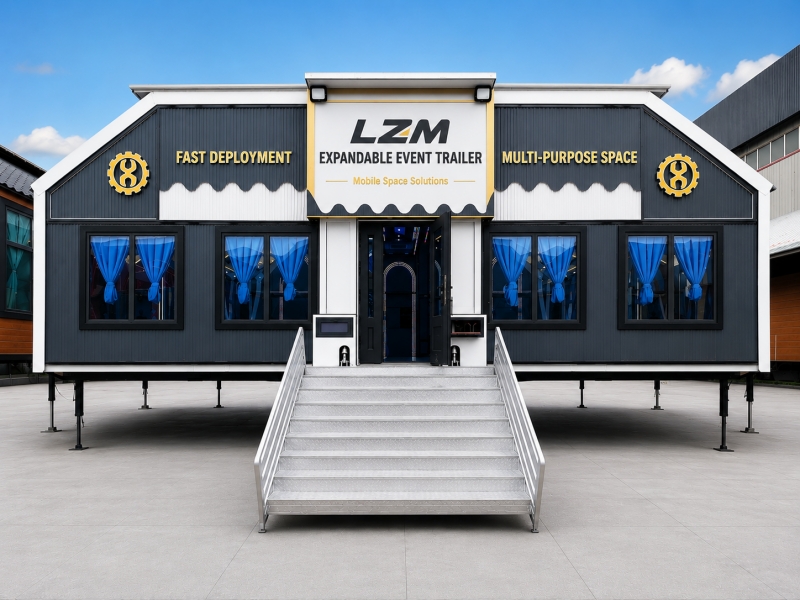
For wedding and event rental companies in Dubai, UAE, an expandable event trailer can introduce a different business model — the reception venue becomes another reusable asset in the rental inventory.
A traditional wedding rental company may provide:
Tables and chairs
Staging
Lighting
Audio systems
Decoration
Bars
Catering equipment
Temporary structures
The client still needs to find a suitable location for the reception.
An expandable event trailer allows the rental company to potentially offer another package:
site + mobile venue + furniture + production equipment + event setup.
The company is no longer supplying only what goes inside the wedding venue.
It can supply the indoor event space itself.
Some wedding clients already have access to an attractive location but lack suitable indoor event infrastructure.
Examples might include:
Private land
Resort grounds
Large gardens
Equestrian properties
Desert event sites
Waterfront locations
Corporate properties
Temporary event locations
The site may be visually suitable for a wedding while having no ballroom or banquet building.
A mobile wedding venue can potentially turn the location into a usable reception site without requiring the property owner to construct a permanent event hall.
The rental company supplies the infrastructure only when it is required.
For a rental operator, purchasing decisions should be based on utilization.
The important question is not simply:
How much does the trailer cost?
A better question is:
How many paid event dates can this facility generate each year?
Suppose the venue can be rented for:
Weddings
Engagement parties
Corporate dinners
Private celebrations
Award ceremonies
Product events
VIP receptions
The same physical asset can potentially generate revenue from several event categories.
Annual utilization is more important than relying on one type of event alone.
Not every client needs the same reception.
A rental company might create several commercial packages around the same venue.
For example:
Venue Only
Expandable reception space with basic interior infrastructure.
Wedding Reception Package
Venue + banquet furniture + lighting + audio.
Premium Wedding Package
Venue + furniture + stage + dance floor + audio + decorative lighting + screens.
Full Event Package
Venue + complete production equipment + external catering infrastructure + additional event services.
The exact commercial packages would depend on the operator.
But thinking in packages can help determine which equipment should be permanently installed and which should remain removable.
A permanent wedding venue can be decorated differently for each client.
A mobile venue should offer the same flexibility.
It may therefore be better to keep some elements removable rather than permanently integrating everything.
Potentially flexible items include:
Banquet tables
Chairs
Stage
Dance floor
Bar
Decorative structures
Screens
DJ equipment
Meanwhile, infrastructure such as electrical systems, lighting provisions, HVAC, hydraulic systems, and selected interior finishes can remain integrated.
The objective is to create a stable venue platform without locking the operator into one wedding style.
Wedding tastes change.
One client may want a minimalist white reception.
Another may prefer gold decoration, flowers, chandeliers, or a darker evening atmosphere.
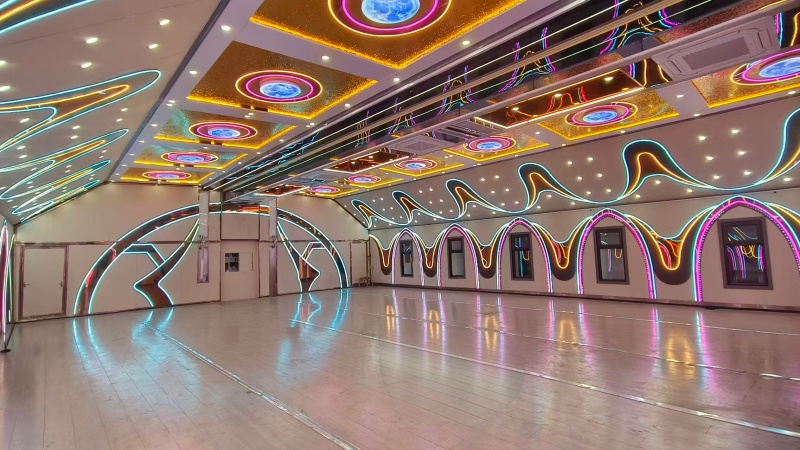
If the rental company owns the facility, the base interior should ideally support different decoration concepts.
A suitable approach may include:
Neutral wall finishes
Decorative ceiling
Adjustable lighting
Concealed wiring
Flexible hanging or mounting positions
Changeable stage backgrounds
Removable furniture
The wedding planner can then create the visual identity for each event without rebuilding the underlying venue.
Rental companies understand this particularly well.
Wedding capacity depends on everything else placed inside the venue.
A banquet may require:
Guest tables
Head table
Stage
Dance floor
DJ or band
Bar
Buffet
Photography area
Service aisles
Therefore, a trailer advertised with a certain maximum occupancy should not automatically be assumed to accommodate the same number of seated banquet guests.
The rental company should first create its preferred standard wedding layout.
That floor plan should determine the appropriate trailer size.
For a mobile wedding venue in Dubai, air conditioning is not a minor option.
It is part of the customer experience.
The cooling system needs to account for:
Guest capacity
Trailer dimensions
Outdoor temperature
Lighting
Audio equipment
Catering activity
Event duration
Frequent door opening
A fully occupied wedding reception creates substantially more heat than an empty trailer.
The HVAC specification should therefore be based on realistic event conditions.
Owning a mobile venue does not mean it can be installed on every site.
Before accepting a booking, the rental company should evaluate whether the proposed location can accommodate the facility.
A site survey may need to consider:
Access road
Turning space
Installation footprint
Ground conditions
Electrical supply
Water requirements
Guest access
Emergency routes
Parking
Catering access
The rental company needs to sell a deployable venue, not simply promise that the trailer can go anywhere.
This makes site assessment an important part of the booking process.
For a rental company, modularity can be particularly useful.
The main expandable trailer can concentrate on high-value guest space, while other functions are supplied separately according to the event.
For example:
Main Trailer: Wedding reception
Separate Unit: Catering
External Facilities: Restrooms
This approach can preserve more interior area for tables, entertainment, and paying guests.
It also allows the rental operator to adjust support facilities according to the size of each wedding.
For larger events, multiple expandable trailers may also be considered as part of the venue strategy.
Depending on the project layout and technical design, two units can be arranged to create additional event capacity.
This gives a rental company another commercial possibility.
One trailer could serve medium-size events, while multiple units could support larger projects.
However, site dimensions, connections, guest circulation, emergency exits, utilities, and local requirements would need to be evaluated for each configuration.
A resort may install an expandable venue and leave it in place for months.
A rental company may move it frequently.
That makes transportation cost a much larger part of the business model.
Before purchasing, the operator should estimate:
Typical distance between events
Towing or transport cost
Setup labor
Setup time
Site preparation
Breakdown time
Storage between events
Maintenance
A rental price that looks profitable before transportation costs may look very different afterwards.
Revenue per booking should be evaluated against the complete deployment cost.
A simple commercial model can help.
For example, the operator can estimate:
Average rental revenue per event × Expected annual bookings
Then subtract:
Transport + Labor + Setup + Maintenance + Storage + Marketing + Financing + Other operating costs
This provides a more useful basis for deciding whether the investment makes sense.
A more expensive configuration may be justified if it allows the company to charge higher rental rates or serve more profitable events.
A cheaper configuration may be better if the local market is highly price-sensitive.
Potential buyers include:
Wedding rental companies
Event rental companies
Wedding planners with their own equipment inventory
Mobile venue operators
Hospitality event companies
Large event production companies
For a company already renting furniture, staging, sound, lighting, and other event equipment, adding a mobile venue can represent an extension of an existing business rather than starting from zero.
Before selecting the trailer size and configuration, the buyer should prepare:
Target wedding capacity
Standard banquet layout
Target rental price
Expected bookings per year
Typical relocation distance
Stage requirements
Dance floor requirements
Furniture strategy
Audio and lighting requirements
HVAC requirements
Catering strategy
Restroom strategy
Typical installation sites
Transportation, road requirements, electrical systems, accessibility, fire safety, public occupancy, event licensing, site permissions, and other applicable requirements should be evaluated according to UAE and local requirements.
Wedding rental businesses already invest in reusable equipment because the same inventory can generate revenue across many events.
An expandable event trailer applies the same principle to a much larger part of the wedding:
the indoor reception space itself.
Instead of supplying only tables, chairs, stages, lighting, and decoration to someone else's venue, an event rental company can potentially add a configurable mobile venue to its own inventory.
For wedding and event rental operators in Dubai and other markets, the commercial value depends on utilization, rental rates, transportation costs, site availability, and the ability to use the facility across weddings and other profitable events.
LZM develops expandable event trailers according to guest capacity, banquet layout, interior configuration, HVAC requirements, equipment strategy, and individual rental business models.
Explore the expandable platform for mobile wedding venue and event rental businesses:
The buyers who move fastest on this product are usually already in the rental trade. They are not planning one wedding; they are judging whether a mobile wedding venue deserves a place in a fleet that is already earning.
When an event rental business asks about an expandable venue, the conversation usually opens with capacity, then moves to money, then to moving the unit:
An event rental business usually wants three numbers before committing: the hire rate the venue can carry in its market, the number of times it can realistically be moved and re-booked in a season, and the point at which the unit has paid for itself. Those three — not the purchase price on its own — decide whether the asset belongs in the inventory.
A rental company already has the enquiry flow, the crew, the transport and the client list. Adding a covered indoor venue means pitching a different product to customers it already serves, rather than building a customer base from nothing. That is also why the fit is usually assessed through utilisation — how many booked days the unit generates — rather than through maximum capacity.
If you already run an event rental business, tell us what you hire out today and how often you turn work away for lack of a covered venue, and we will come back with the configuration that matches it.
Expandable Wedding Venue for Event Rental Companies