Welcome: Laizhou Machinery Group



An international buyer sends the same inquiry to three expandable event trailer suppliers.
A few days later, three quotations arrive:
Supplier A: USD 78,000
Supplier B: USD 96,000
Supplier C: USD 118,000
At first glance, comparing them seems easy.
Why pay USD 118,000 if another manufacturer offers an apparently similar trailer for USD 78,000?
The problem is that “21-meter expandable event trailer” does not describe everything included in the product.
Different quotations may contain different structural specifications, hydraulic systems, HVAC equipment, interior finishes, electrical systems, optional equipment, and delivery scopes.
Before comparing prices, buyers need to determine whether they are actually comparing the same configuration.
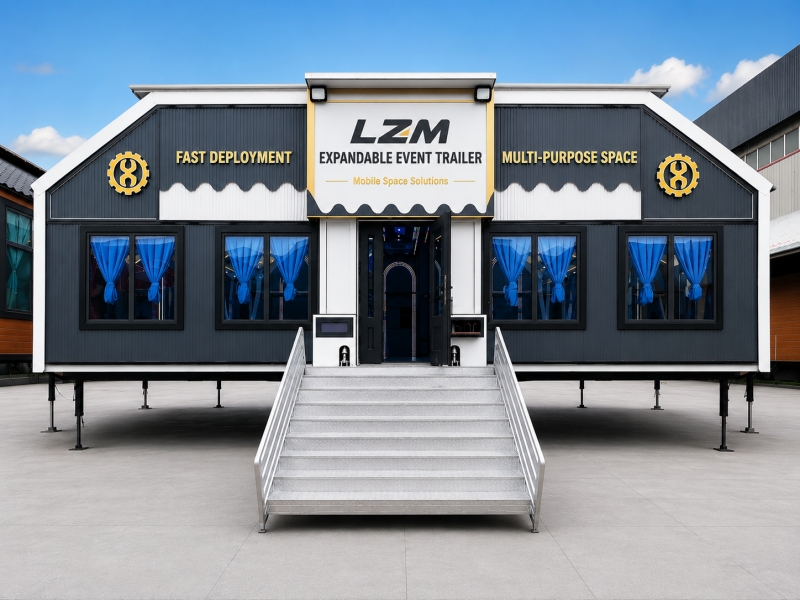
Two suppliers may both describe their product as a 15m, 17m, or 21m expandable event trailer.
That does not necessarily mean the usable event space is identical.
Compare:
Transport length
Transport width
Transport height
Expanded width
Interior clear dimensions
Floor area after expansion
Interior height
Expansion structure
Transport length alone is not enough to compare usable event capacity.
Buyers planning weddings, banquets, conferences, or other high-capacity events should compare the actual expanded interior dimensions and intended layout.
This is one of the most important questions for international buyers.
A quotation might cover:
Complete trailer
or
Expandable body only
These are not equivalent products.
A complete trailer may include chassis, axles, suspension, braking components, lighting, towing interfaces, and other road-related systems.
A body-only configuration focuses on the expandable event structure and may be intended for integration with a locally sourced chassis or another transport solution.
For some international markets, the second approach may be worth considering because road regulations, trailer registration, dimensions, braking, lighting, and certification requirements vary between countries.
Always confirm exactly what the quoted price includes.
The hydraulic system is central to the operation of an expandable trailer.
Buyers should ask what functions are hydraulically operated.
Depending on the configuration, these may include:
Side expansion
Supporting legs
Roof lifting
Floor deployment
Leveling functions
It is also useful to understand:
Hydraulic power unit
Control method
Emergency operation
Component accessibility
Maintenance requirements
Spare-parts availability
A lower quotation may not represent the same hydraulic configuration.
Air conditioning is another area where quotations can appear similar while actually being very different.
Do not compare only:
“Air conditioning included.”
Ask:
How many units?
What capacity?
Cooling only or heating and cooling?
Where are the units installed?
What climate was the system selected for?
What occupancy was assumed?
A trailer intended for Dubai, Riyadh, Texas, Singapore, or another hot market may require substantially different cooling capacity from one operating in a mild climate.
HVAC should be evaluated against the destination and expected number of occupants.
Electrical configuration can vary between markets.
Before comparing quotations, check:
Voltage
Frequency
Single-phase or three-phase supply
Distribution system
Circuit protection
Number of outlets
Lighting
HVAC load
Equipment power requirements
LZM expandable event trailer projects commonly use 380V three-phase power, with 50Hz or 60Hz depending on project requirements.
However, buyers should provide the destination country's electrical requirements and intended equipment before the final system is confirmed.
Two quotations may both say that interior finishing is included.
The actual interiors could still be very different.
Compare details such as:
Floor finish
Wall panels
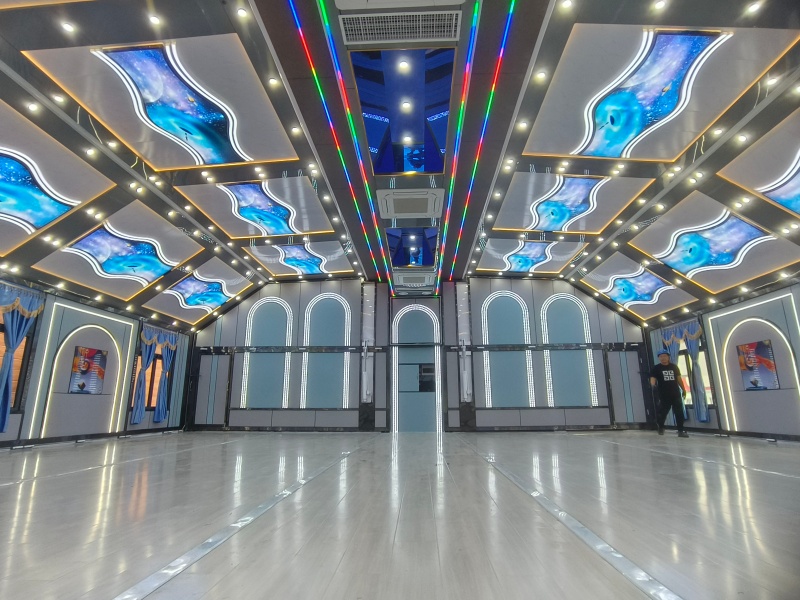
Ceiling system
Decorative lighting
Windows
Doors
Insulation
Interior partitions
Wiring concealment
Decorative materials
If interior appearance is commercially important—for example, for weddings, VIP hospitality, luxury retail, or corporate events—buyers should request photos or videos showing comparable completed projects.
A written phrase such as “luxury interior” is not a technical specification.
Some suppliers may include equipment in the headline price that another supplier lists separately.
Potential options can include:
Sound system
LED screen
Projector
Stage
Specialized lighting
Furniture
Bar
Kitchen equipment
Restroom
Additional HVAC
Exterior branding
Before comparing total prices, create one common equipment list and ask each supplier to quote against the same requirements.
Otherwise, the cheapest quotation may simply contain fewer components.
International buyers should also understand what they will eventually need to transport.
Important information may include:
Approximate total weight
Axle configuration
Transport dimensions
Towing requirements
Shipping method
Loading and unloading requirements
Large expandable event trailers can create very different logistics requirements from conventional containerized products.
Shipping costs should therefore be evaluated before the purchasing decision is made—not after production is completed.
Price comparison becomes even more misleading when suppliers use different Incoterms or delivery scopes.
For example:
USD 85,000 EXW
cannot be directly compared with:
USD 100,000 including inland transport and international freight.
Buyers should identify whether the quotation includes:
Factory price
Chinese inland transportation
Port charges
Export handling
Ocean freight
Destination-port charges
Import duties
Local delivery
For very large trailers, international logistics can represent a meaningful part of the overall project cost.
Expandable event trailers combine structure, hydraulics, electrical systems, HVAC, and customized interior components.
Buyers should therefore ask about:
Operating instructions
Installation guidance
Technical support
Spare parts
Hydraulic components
Electrical documentation
Maintenance recommendations
The importance of each item depends on the project and how frequently the trailer will be relocated.
A rental company operating the trailer every week may have different after-sales priorities from a resort that deploys it only several times per year.
A manufacturer's quotation should not be interpreted as automatic confirmation that the finished trailer can be registered or operated in every destination country.
International buyers need to evaluate applicable local requirements concerning:
Road dimensions
Weight
Axles
Braking
Lighting
Electrical systems
Fire safety
Public occupancy
Accessibility
Structural requirements
Local requirements should be investigated before the final manufacturing specification is approved.
Where complete imported trailer compliance is difficult, buyers may also evaluate whether an expandable body combined with a locally compliant chassis is a more practical approach.
Instead of comparing only the final price, create a simple quotation comparison sheet.
| Item | Supplier A | Supplier B | Supplier C |
|---|---|---|---|
| Transport dimensions | ✓ | ✓ | ✓ |
| Expanded dimensions | ✓ | ✓ | ✓ |
| Complete trailer/body only | ✓ | ✓ | ✓ |
| Hydraulic system | ✓ | ✓ | ✓ |
| HVAC capacity | ✓ | ✓ | ✓ |
| Electrical specification | ✓ | ✓ | ✓ |
| Interior materials | ✓ | ✓ | ✓ |
| Optional equipment | ✓ | ✓ | ✓ |
| Total weight | ✓ | ✓ | ✓ |
| Shipping scope | ✓ | ✓ | ✓ |
| Technical support | ✓ | ✓ | ✓ |
Once every supplier answers the same questions, the price comparison becomes much more meaningful.
This does not mean buyers should automatically select the highest-priced supplier.
A lower-priced trailer may genuinely offer better value.
The important point is that price should be compared after specification—not before it.
A useful purchasing sequence is:
Application → Required Layout → Technical Specification → Included Equipment → Compliance Strategy → Logistics → Supplier Comparison → Final Price
If two suppliers meet the same requirements and one offers a significantly better price, the commercial decision becomes much clearer.
But if their specifications are different, comparing only the number at the bottom of the quotation can lead to the wrong conclusion.
LZM provides customized expandable event trailer quotations according to trailer size, interior configuration, equipment requirements, destination market, and intended application.
Review the expandable event trailer platform before preparing your quotation comparison:
Expandable Event Trailer Specifications & Quotation Options