Welcome: Laizhou Machinery Group



For an off road caravan designed for remote travel, the water system is more than a convenience feature.
It determines how long travellers can remain away from established campsites and affects payload, weight distribution, plumbing design and overall caravan configuration.
For Australian caravan dealers developing an OEM model, simply requesting "a bigger water tank" is not enough.
The complete system should consider:
Fresh water capacity
Grey water storage
Hot water requirements
Water pumps
Filtration
Tank position
Plumbing protection
Total loaded weight
The correct configuration depends on how customers will actually use the caravan.
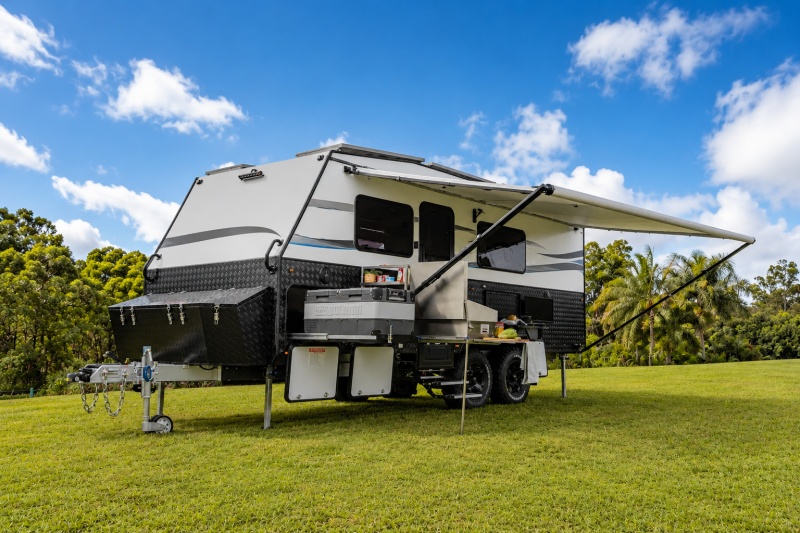
There is no universal answer.
Required capacity depends on:
Number of travellers
Length of the trip
Availability of refill points
Shower usage
Cooking requirements
Climate
Remote travel duration
A couple travelling between serviced campsites has very different requirements from a family spending several days in a remote area.
For dealers, customer profile should determine water capacity rather than simply selecting the largest tank available.
This is one of the most important technical considerations.
Approximately:
1 litre of water = 1 kilogram of mass.
Therefore:
100 L ≈ 100 kg
200 L ≈ 200 kg
300 L ≈ 300 kg
A dealer requesting substantially larger water capacity must consider what this does to:
Payload
Chassis loading
Suspension
Tow requirements
Weight distribution
This becomes particularly important when the caravan also contains large lithium batteries, additional solar equipment and other heavy options.
Two caravans carrying the same quantity of water may behave differently if the tanks are installed in different positions.
Water tank placement can influence:
Weight distribution
Towing balance
Ground clearance
Available storage
Chassis loading
For this reason, increasing tank capacity may require more than simply installing a larger tank in an available space.
The complete layout should be evaluated.
The fresh water system supplies water for applications such as:
Sink
Shower
Cooking
General washing
Grey water is wastewater generated from activities such as:
Showering
Hand washing
Kitchen sink use
Depending on the intended application and destination requirements, a caravan may require separate fresh and grey water storage.
Dealers should define these requirements before production.
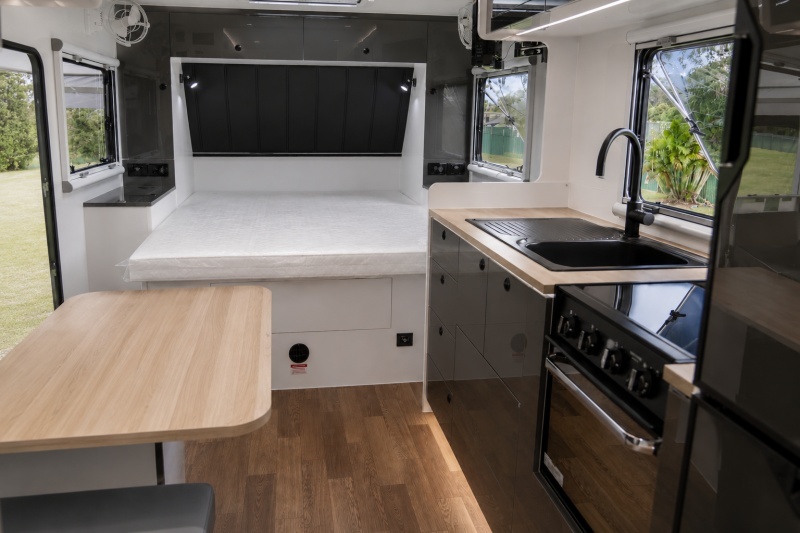
In some configurations, using more than one tank may provide practical advantages.
Possible considerations include:
Weight distribution
Packaging space
Separate water supplies
Easier system design
However, more tanks also introduce additional:
Plumbing
Valves
Connections
Potential maintenance points
The correct design depends on the caravan platform and required capacity.
Tank capacity receives most of the attention, but the pump is what makes the system usable.
When developing an OEM caravan, the water system should consider:
Pump capacity
Operating pressure
Noise
Electrical consumption
Accessibility
Replacement availability
For dealers, choosing serviceable components can make future after-sales support easier.
That depends on how and where customers obtain water.
Possible filtration requirements may include systems intended to improve water quality before use.
The appropriate solution depends on:
Water source
Intended use
Customer expectations
Filter replacement availability
Dealers should also consider whether replacement filter elements can be obtained conveniently in the local market.
A sophisticated filtration system has limited commercial value if replacement consumables become difficult for customers to obtain.
Hot water can significantly improve comfort during longer trips.
Customers may require hot water for:
Showering
Kitchen use
Washing
When selecting a hot water system, dealers should consider:
Energy source
Capacity
Recovery time
Installation space
Electrical demand
Service requirements
The hot water solution should also be coordinated with the caravan's overall electrical or energy system.
Modern caravan systems should not be designed independently.
For example, adding electrically powered hot water equipment may increase demand on:
Battery capacity
Inverter
Charging system
Solar generation
At the same time, larger batteries and larger water tanks both consume payload.
This means the dealer may need to balance:
water capacity + battery capacity + customer equipment + available payload
rather than maximizing every specification.
Off road operation introduces vibration, movement and potential impact.
Water system design should therefore consider:
Pipe routing
Connection security
Tank mounting
Component protection
Accessibility for inspection
Components installed underneath the caravan may require appropriate protection according to their position and intended road conditions.
Dealers should ask whether important components can be accessed for:
Inspection
Cleaning
Pump replacement
Filter replacement
Leak diagnosis
Winter or long-term storage procedures where relevant
Good serviceability reduces unnecessary work when maintenance is eventually required.
This is particularly important for dealers supporting multiple caravans after sale.
There is no correct answer for every product.
A caravan aimed at extended remote travel may justify higher water capacity.
A model aimed primarily at serviced caravan parks may benefit more from preserving payload for:
Customer belongings
Outdoor equipment
Food
Other accessories
This is why dealers should first define the intended use case, then determine the specification.
Before confirming an OEM water system, ask:
What fresh water capacities are available?
Is grey water storage available?
Where are the tanks positioned?
How does full water capacity affect payload?
What water pump is used?
Can the pump be accessed for servicing?
Are filtration options available?
What hot water systems can be installed?
How are tanks and plumbing protected?
Can replacement components be sourced locally?
Can the same plumbing configuration be repeated on future orders?
These questions help turn a list of components into a practical dealer specification.
LZM works with international caravan dealers and importers requiring different off-grid configurations.
Water storage, electrical systems, interior layouts and other equipment can be evaluated together according to the intended application.
Dealers developing remote-travel products can explore the Off Grid Caravan Solutions for Dealers.
A larger family caravan may require a different water strategy from a compact two-person model.
For the 21ft platform, the water system can be discussed together with:
Family occupancy
Interior layout
Battery system
Storage
Expected off-grid duration
Overall weight requirements
Explore the 21ft Family Off Road Caravan for Extended Travel.
For an Australian dealer developing an OEM caravan, useful information includes:
Number of occupants
Expected off-grid duration
Required fresh water capacity
Grey water requirements
Shower requirements
Hot water requirements
Battery configuration
Other major options
Expected order quantity
LZM can evaluate these requirements as part of the complete caravan configuration.
For off road caravans, more water is not automatically better.
Additional water increases independence, but it also consumes payload and affects chassis loading, suspension and weight distribution.
The best water system is therefore one that balances fresh water capacity, wastewater management, hot water, serviceability and total caravan weight according to the customer's actual travel requirements.
For Australian dealers, considering these factors during OEM development can create a more practical product than simply competing on the largest advertised tank capacity.