Welcome: Laizhou Machinery Group



A buyer can choose the right trailer size, design an excellent floor plan and select a premium interior—and still end up with a venue that cannot operate properly at the event site.
The reason can be surprisingly simple:
There is not enough electrical power available.
An expandable event trailer can contain much more electrical equipment than buyers initially expect.
A typical commercial configuration may use electricity for:
HVAC
Interior lighting
Exterior lighting
LED displays
Audio equipment
Computers
Refrigeration
Catering equipment
Hydraulic systems
Internet and communication equipment
Other event technology
The required power supply therefore cannot be determined by trailer length alone.
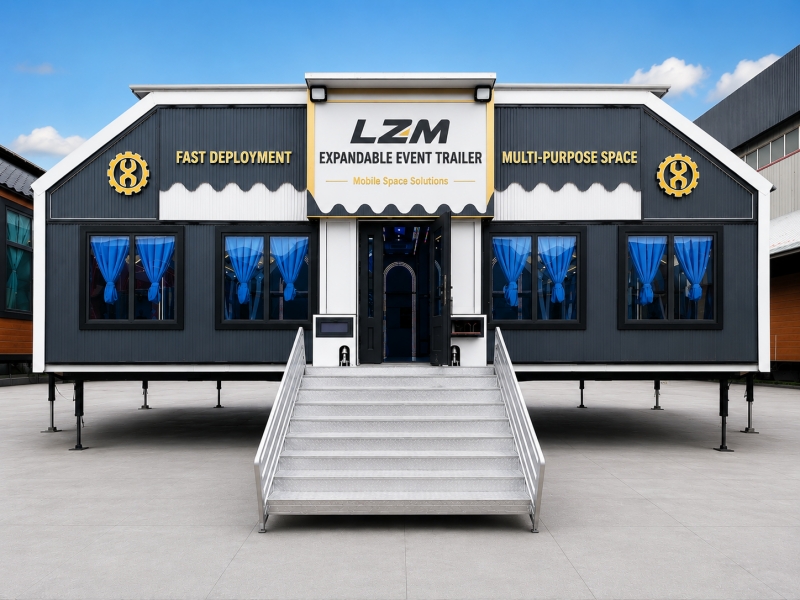
A 15m wedding venue and a 15m brand activation trailer may have completely different electrical loads.
The correct question is:
What equipment will operate at the same time, and how much power does the complete venue require under peak operating conditions?
It would be convenient to say:
“Every 15m expandable event trailer requires X kW.”
But that would be misleading.
Electrical demand depends heavily on the application.
Consider four trailers of the same size.
May require:
High-capacity HVAC
Decorative lighting
LED screens
Sound system
Refrigeration
Beverage equipment
May use:
LED walls
Interactive displays
Computers
Digital signage
HVAC
Professional lighting
May require:
HVAC
General lighting
Food-service equipment
Digital displays
Serving equipment
May use:
HVAC
Lounge lighting
LED screens
Refrigeration
Coffee equipment
AV systems
The structure may be similar.
The electrical system is not.
Before determining the required electrical supply, the buyer should create a list of all major electrical equipment.
A useful table might include:
| Equipment | Quantity | Rated Power | Expected Simultaneous Use |
|---|---|---|---|
| HVAC | — | Manufacturer data | Yes |
| LED screens | — | Manufacturer data | Yes |
| Lighting | — | Calculated total | Yes |
| Audio equipment | — | Equipment data | Usually |
| Refrigerators | — | Equipment data | Yes |
| Kitchen equipment | — | Equipment data | Depends |
| Computers / IT | — | Equipment data | Yes |
The exact values should come from the selected equipment.
Do not guess them from similar-looking projects.
For many expandable event trailers, climate control is one of the biggest power consumers.
That is especially true in:
Saudi Arabia
UAE
Texas
Australia
Tropical Asia
Other hot or humid markets
HVAC capacity depends on more than floor area.
The calculation should consider:
Expanded interior volume
Number of guests
Outdoor temperature
Humidity
Solar exposure
Lighting
LED screens
Catering equipment
Door-opening frequency
A wedding hall filled with 200 guests creates a very different cooling load from an empty trailer displayed at the factory.
HVAC should be specified for the operating event, not the empty building.
Guest count does not consume electricity directly, but it strongly affects HVAC.
Every person inside contributes heat.
A high-capacity banquet may therefore require more cooling than a lower-density corporate lounge using the same trailer.
This is another reason why electrical planning should follow the actual floor plan and event capacity.
The sequence should be:
Application → Capacity → HVAC Requirement → Electrical Load
rather than choosing the electrical system first.
Large LED displays are common in:
Weddings
Corporate events
Brand activations
Sports hospitality
Product launches
But “LED screen included” tells the electrical engineer almost nothing.
The buyer should define:
Screen dimensions
Quantity
Pixel specification where relevant
Indoor or outdoor configuration
Manufacturer power data
Expected operating mode
A small presentation display and a large LED wall can have dramatically different power requirements.
Exterior LED screens can add another substantial load.
General interior lighting may represent a relatively modest load.
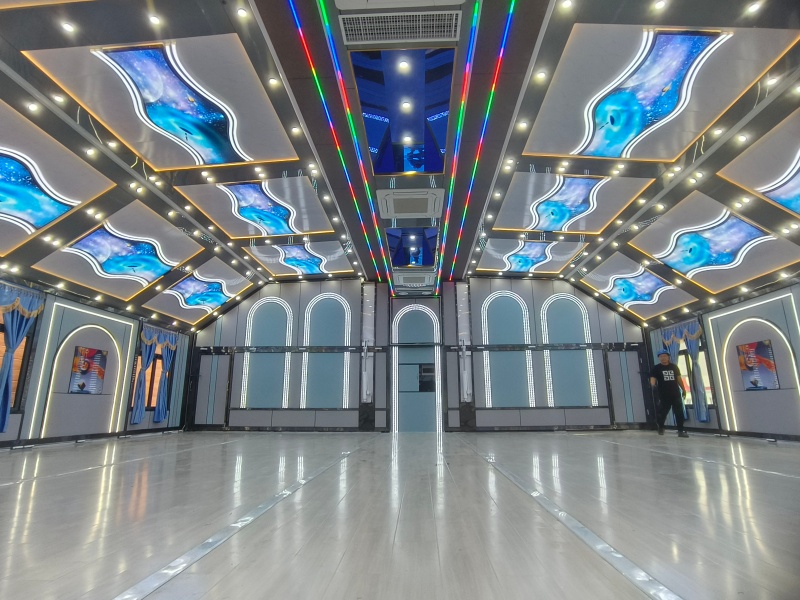
Event-production lighting can be very different.
A premium venue might use:
Ceiling lighting
Decorative lighting
Entrance lighting
Exterior lighting
Moving lights
Effect lighting
Photography lighting
The electrical design should distinguish between:
Permanent Venue Lighting
and
Temporary Event Production Equipment.
If a rental company plans to connect additional professional lighting at every event, that future load should be considered when sizing the electrical infrastructure.
Wedding and corporate customers may bring professional audio equipment.
This could include:
Main speakers
Subwoofers
Amplifiers
Mixers
Wireless microphone systems
DJ equipment
The power requirement may not be as large as HVAC, but it still forms part of the total system.
More importantly, sensitive AV equipment benefits from properly planned electrical distribution.
The venue should not depend on random extension cables added after installation.
This is one of the biggest variables.
A banquet venue where food is prepared elsewhere may require only:
Beverage refrigeration
Service equipment
Coffee machines
Small food-warming equipment
A trailer with a complete kitchen may require:
Ovens
Cooktops
Refrigeration
Freezers
Dishwashing
Extraction
Food-warming equipment
The second configuration can have a much larger electrical demand.
This is why buyers should decide early:
Is food being prepared inside the event trailer or only served there?
The answer can materially affect the electrical system.
A hotel or resort may already provide:
Kitchen
Refrigeration
Restrooms
Catering equipment
In this case, the expandable trailer may primarily require power for:
HVAC + Lighting + AV + Guest Equipment
That can simplify the electrical design.
The same principle applies to school projects where food is produced in an existing central kitchen.
The trailer should not duplicate electrical loads that can remain in existing infrastructure unless the business model requires it.
International buyers should specify the destination electrical standard before production.
Important information includes:
Voltage
Frequency
Single-phase or three-phase requirements
Available site supply
Applicable local electrical standard
Different markets use different electrical systems.
A trailer designed for one country should not simply be shipped to another and assumed to be compatible.
Electrical requirements need to be confirmed during the project engineering stage.
This is a common project question.
Small equipment may operate on single-phase power.
Larger commercial HVAC systems and other high-load equipment may require or benefit from three-phase supply, depending on the selected equipment and destination electrical system.
There is no responsible universal answer such as:
“All expandable trailers require three phase.”
The correct solution depends on:
Total load
HVAC
Equipment selection
Available site supply
Local electrical standards
Buyers should confirm the available power at their normal operating sites before finalizing the trailer specification.
Imagine a trailer that requires substantial electrical capacity.
The manufacturer can build the system.
But the customer's event site has only a limited connection.
The problem has simply moved from the factory to the venue.
This is particularly important for mobile operators because every site can be different.
A hotel may have substantial electrical infrastructure.
A private wedding estate may have less.
A festival field may have almost none.
An event rental company should therefore understand:
What power supply do our typical customers actually have available?
Where suitable grid power is unavailable, a generator can provide another power source.
However, generator sizing should be based on the actual electrical load.
An undersized generator can create operating problems.
An unnecessarily oversized generator can increase:
Purchase or rental cost
Fuel consumption
Transport requirements
Noise
Site-space requirements
The generator supplier or qualified electrical professional should therefore size the system according to the project's real loads and operating characteristics.
Simply adding every rated wattage can also produce an inaccurate result.
Electrical planning may need to consider:
Which equipment operates simultaneously
Starting current
HVAC compressor behavior
Motor loads
Peak demand
Continuous demand
Future expansion
Appropriate safety margin
This is why a qualified electrical designer or engineer should confirm the final supply arrangement for commercial projects.
Some equipment draws more current when starting than during steady operation.
This can be relevant to:
Compressors
Pumps
Motors
Refrigeration
Certain HVAC systems
A power source that appears adequate based only on normal operating load may still experience problems during equipment startup.
The electrical design therefore needs to consider both:
Running Load
and
Peak / Starting Conditions.
Expandable trailers also use power for deployment-related systems.
Depending on the design, hydraulic systems may control:
Side expansion
Retraction
Supports
Other structural movements
This load behaves differently from normal event operation because expansion occurs during setup rather than continuously throughout the event.
Nevertheless, the operating procedure needs a defined power source.
The buyer should understand how the hydraulic system is powered and what is required during deployment.
Some buyers ask whether batteries can operate the entire event venue.
Technically, battery-based systems can be developed for many loads, but the economics and required capacity depend heavily on the project.
Running large HVAC systems for long periods requires much more energy than powering:
Emergency lighting
Controls
Computers
Small electronics
A battery system should therefore begin with a clearly defined purpose.
Possible objectives include:
Backup for controls
Emergency systems
Short-duration operation
Selected low-load equipment
It should not automatically be assumed that a small battery pack can replace the main commercial power source for a large climate-controlled venue.
Expandable trailers can potentially incorporate solar generation where technically appropriate.
But roof area is finite.
A large event venue may consume substantial electricity through HVAC, screens and other systems.
Solar may therefore support part of the energy strategy without necessarily supplying the entire venue under all operating conditions.
The buyer should compare:
Available Solar Generation
with
Actual Event Energy Consumption.
The numbers—not marketing language—should determine the design.
Getting electricity into the trailer is only the first step.
The system also needs to distribute power safely to the equipment.
The electrical layout may include:
Main distribution panel
Branch circuits
Protection devices
HVAC circuits
Lighting circuits
AV circuits
General outlets
Dedicated equipment circuits
The exact design should comply with the applicable project requirements and destination standards.
High-load equipment should not necessarily share the same circuits as sensitive electronics.
For example:
HVAC
and
AV / Computer Equipment
may have different electrical requirements.
A properly planned electrical system reduces reliance on temporary improvisation during events.
This is particularly important for commercial rental companies where the trailer needs to operate consistently across repeated bookings.
Buyers often focus on how many outlets are included.
Position can be just as important.
A wedding venue may need outlets near:
DJ equipment
LED screens
Service areas
Entrance
Catering stations
A brand activation may need them near:
Interactive displays
Product installations
Registration desks
Digital screens
The electrical layout should therefore follow the intended interior plan.
Event professionals frequently use temporary cabling.
But the base trailer should still provide sensible power distribution.
If every event requires cables running across guest pathways because outlets are in the wrong locations, the original electrical design was poorly matched to the application.
Cable routing and equipment positions should be considered during manufacturing.
Some events use equipment outside the trailer.
Examples include:
Exterior LED screens
Entrance lighting
Outdoor displays
Catering equipment
Decorative lighting
Registration equipment
If the trailer is expected to supply these systems, the external loads need to be included in the project.
Do not calculate only the interior electrical demand.
Electrical connections exposed to outdoor conditions may need different protection from equipment installed inside the venue.
Potential environmental factors include:
Rain
Dust
Humidity
Heat
Coastal conditions
The design should follow applicable destination requirements and the intended installation environment.
High humidity and airborne salt can affect more than the steel frame.
Exposed electrical components and connections also need suitable consideration.
For coastal operation, the buyer should identify:
Outdoor electrical equipment
Exposed connectors
External lighting
Control components
during the project specification stage.
Environmental protection should be designed deliberately rather than discovered after long-term operation begins.
A beautiful event lighting system does not automatically satisfy emergency requirements.
Projects may require dedicated emergency lighting or other life-safety electrical systems according to local regulations and intended occupancy.
These requirements should be identified for the destination market.
They should not be confused with the decorative lighting package selected for the event atmosphere.
This is worth emphasizing.
A wedding trailer might prioritize:
HVAC + Decorative Lighting + Audio + LED Wall + Catering Support
A brand activation might prioritize:
HVAC + Multiple Screens + Computers + Interactive Equipment + Exterior Displays
Even if both trailers have exactly the same dimensions, the electrical systems may differ significantly.
The application should therefore be defined before the electrical specification.
A school cafeteria and activity hall can require:
HVAC
General lighting
Serving equipment
Digital displays
Cleaning equipment
Occasional activity AV systems
If food is cooked elsewhere, the electrical load may remain considerably lower than a full kitchen configuration.
Again, the business process determines the power requirement.
The most important load condition is not necessarily an average quiet hour.
For commercial venues, design needs to consider the periods when:
The hall is full
HVAC is working hard
Screens are operating
Lighting is active
Audio is running
Refrigeration is operating
Catering equipment is in use
This represents the moment when the electrical system is under the greatest demand.
Peak conditions should be evaluated before the power supply is finalized.
A rental company may purchase the trailer with one LED screen today and add more technology later.
A wedding venue may eventually upgrade AV equipment.
A brand agency may introduce interactive installations.
Where future expansion is reasonably predictable, electrical planning can consider additional capacity.
But excessive oversizing also increases cost.
The objective is a sensible balance between:
Today's Requirement
and
Realistic Future Expansion.
For preliminary electrical planning, buyers should provide:
Destination country
Voltage
Frequency
Available phase
Target guest capacity
HVAC requirements
LED screen dimensions
Lighting equipment
Audio equipment
Refrigeration
Catering equipment
Computers and interactive systems
Exterior electrical equipment
Generator requirements if known
Expected future additions
The more complete the equipment list, the more meaningful the electrical proposal can become.
Commercial buyers can think about the project in this order:
1. Define the application
Wedding, banquet, brand activation, hospitality, school dining or another use.
2. Define occupancy
How many people will use the venue?
3. Select HVAC
Based on climate and occupancy.
4. List major equipment
Screens, lighting, audio, refrigeration, kitchen equipment, etc.
5. Confirm destination electrical supply
Voltage, frequency and phase.
6. Calculate operating and peak loads
Using actual equipment data.
7. Determine the power source
Grid connection, generator or another properly engineered solution.
8. Design distribution
Panels, circuits, outlets and equipment locations.
This is much safer than choosing a generic electrical package from a brochure.
Electrical systems are much easier to design correctly during manufacturing than modify after delivery.
The buyer should therefore avoid:
Order Trailer → Ship Trailer → Ask Event Site What Power Is Available
A better sequence is:
Understand Operating Sites → Define Equipment → Calculate Load → Design Electrical System → Manufacture Trailer
For mobile operators serving many locations, the trailer's power requirements should also become part of every site survey.
Expandable event trailers are often evaluated visually.
Buyers see:
Large indoor area
Luxury interiors
LED displays
Banquet layouts
Brand graphics
Behind all of that is an electrical system that makes the venue operate.
Without correctly planned power, the HVAC, lighting, screens and equipment that create the event experience cannot function reliably.
For that reason, electrical capacity should be treated as a core technical specification alongside:
Dimensions + Weight + Layout + HVAC + Structure + Chassis.
LZM develops expandable event trailers according to the intended application and can coordinate project-specific electrical systems, HVAC, lighting, LED display provisions and interior equipment requirements based on the buyer's destination and configuration.
Review expandable event trailer configurations and discuss the electrical requirements for your project:
Expandable Event Trailer Electrical & Configuration Options