Welcome: Laizhou Machinery Group



Buying the first expandable event trailer is relatively straightforward.
Building a profitable event trailer fleet is more complicated.
An event rental company may begin by asking:
Should we purchase the largest expandable event trailer available so we can accept the biggest events?
That sounds logical.
A larger venue can potentially serve larger weddings, corporate functions and hospitality events.
But another strategy is possible:
Start with a medium-size trailer, understand real booking demand, and add different sizes as the rental business grows.
Neither strategy is automatically correct.
For a commercial rental operator, the decision should be based on booking utilization, customer capacity, event sites, transportation and rental rates rather than trailer size alone.
An expandable event trailer is not simply equipment.
For a rental company, it is an income-producing asset.
The business needs the trailer to:
Attract bookings
Fit customer sites
Meet event capacity requirements
Move efficiently between projects
Generate an appropriate rental rate
Remain occupied frequently enough to justify the investment
This creates a fundamental difference between a private buyer and a rental operator.
A private wedding venue may optimize the trailer for one property.
A rental company needs to think about many customers and many locations.
The argument for buying a large expandable event trailer is simple:
More Space = More Potential Capacity
A larger unit can potentially support:
Large wedding receptions
Banquets
Corporate hospitality
Major private events
Brand activations
Sports hospitality
It may also allow the rental company to compete for projects that smaller temporary venues cannot accommodate.
For companies already receiving frequent enquiries for large indoor event space, this can be a strong advantage.
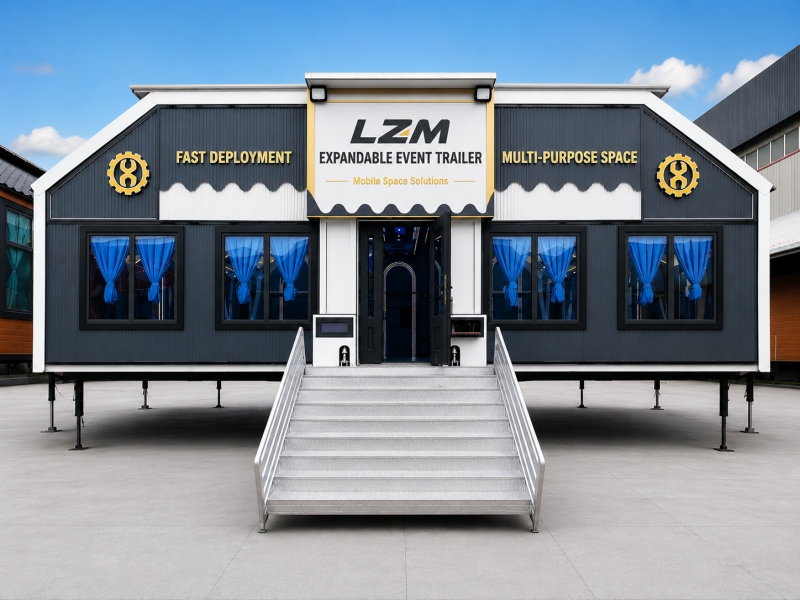
A 21m expandable trailer may create an impressive venue.
But what happens if most local customers actually need a medium-size space?
The rental company may repeatedly deploy a large asset for relatively small bookings.
That can create unnecessary:
Transportation requirements
Site-space requirements
HVAC demand
Power demand
Operating cost
The important question is therefore not:
What is our maximum possible event size?
It is:
What event size do customers request most frequently?
That difference should influence the first purchase.
Established rental companies already have valuable market research.
It is sitting in their:
Emails
WhatsApp enquiries
Quotations
CRM
Lost-booking records
Review the previous 6–12 months.
How many customers requested events for:
50–100 guests?
100–150 guests?
150–200 guests?
200+ guests?
Then separate those enquiries by event type.
For example:
| Event Type | Typical Demand |
|---|---|
| Weddings | Banquet seating + dance space |
| Corporate events | Theater or mixed seating |
| Brand activations | Open visitor circulation |
| VIP hospitality | Lower-density lounge layout |
| Private parties | Flexible seating + entertainment |
This gives the operator a much clearer picture of what trailer size is likely to earn revenue.
Completed bookings tell you what your current equipment can serve.
Lost bookings tell you where the opportunity may be.
Suppose a rental company repeatedly receives enquiries for 180–250-person wedding receptions but cannot provide a suitable enclosed venue.
Those lost enquiries may support investment in a larger expandable trailer.
Conversely, if almost no customers request large events, buying the largest model simply because it is available may not make commercial sense.
There is another argument for starting large.
A major expandable trailer can become a flagship rental product.
Instead of competing with ordinary tents or small mobile facilities, the rental company can market:
A premium expandable mobile event venue.
This may help position the business for higher-value:
Weddings
Corporate hospitality
Luxury private events
Sponsor events
Large brand activations
In this model, the trailer is not intended to serve every enquiry.
It targets a higher-value segment.
Larger is not always easier to rent.
Event sites can have restrictions involving:
Entrance width
Access roads
Turning space
Parking
Ground conditions
Expanded footprint
Utility access
A medium-size expandable trailer may be suitable for more locations.
That can matter greatly for rental companies because they do not control the customer's site.
The operator needs an asset that can physically reach and deploy at a high percentage of potential booking locations.
Rental companies should record more than event capacity.
They should also track:
Why could we not serve this site?
Possible reasons include:
Insufficient access
Insufficient deployment area
Difficult terrain
Electrical limitations
Transport restrictions
Over time, this data can reveal whether the fleet needs:
more capacity
or
more deployment flexibility.
These are not the same problem.
As the business grows, a fleet with different trailer sizes can create another advantage.
For example:
Smaller / Medium Unit
for corporate events, smaller weddings and brand activations.
Larger Unit
for major weddings, banquets and hospitality events.
This allows the operator to match the asset to the booking.
A customer does not need to pay for an oversized venue.
The rental company does not need to deploy its largest equipment for every project.
Fleet segmentation can also create pricing tiers.
Instead of offering one event venue, the rental company can offer:
Package A — Medium Event Venue
Package B — Large Event Venue
Package C — Premium High-Capacity Venue
Additional options can then be added for:
HVAC
LED displays
Furniture
Lighting
Branding
Event equipment
This gives the sales team more flexibility when responding to customers with different budgets.
Multiple trailers increase market coverage.
They also increase:
Purchase investment
Storage requirements
Maintenance
Insurance
Transportation planning
Staffing
Spare parts
Fleet management
A rental company should therefore not build a large fleet before understanding actual utilization.
The goal is not to own the most trailers.
The goal is to own the right combination of revenue-producing trailers.
Consider two businesses.
Company A
Owns four trailers but each is rented 30 days per year.
Company B
Owns two trailers but each is rented 100 days per year.
Company A has the larger fleet.
That does not automatically mean it has the stronger business.
Commercial operators should track metrics such as:
Rental days per year
Revenue per unit
Revenue per rental day
Average booking duration
Transportation cost per booking
Setup cost
Maintenance cost
Number of rejected enquiries
These numbers help determine when another trailer should be purchased.
A rental company should be able to answer:
Why are we buying unit number two?
Good answers might include:
Our existing trailer is fully booked during peak wedding season.
We are losing smaller events because our current unit is too large.
We are receiving repeated enquiries for higher-capacity venues.
We need to serve two events simultaneously.
Brand activation customers need a different interior configuration.
These are clear commercial reasons.
A weak reason is:
We want a bigger fleet.
One trailer can only be in one location at a time.
This creates an important fleet limitation.
Imagine that Saturday is the busiest wedding day of the month.
Two customers want the same trailer.
The rental company must reject one booking.
As demand grows, a second unit may generate value even if it is the same size as the first.
Fleet expansion therefore does not always mean adding a different model.
Sometimes it means adding capacity to serve simultaneous events.
Another reason for multiple units is specialization.
A wedding-oriented trailer may have:
Premium decorative interior
Banquet-focused lighting
Wedding-friendly finishes
A brand activation trailer may prioritize:
Rebranding
LED screens
Product displays
Open circulation
A corporate hospitality unit may need:
Lounge seating
Meeting areas
Presentation facilities
Trying to make one trailer perfect for every application can create compromises.
Once demand is sufficient, specialized units may produce a better customer experience.
Before a company knows which market will generate the most bookings, excessive specialization creates risk.
A flexible first unit can potentially serve:
Wedding → Corporate Event → Private Party → Hospitality → Brand Activation
through changes in:
Furniture
Decoration
Graphics
Digital content
Layout
The operator can then track which applications generate the strongest demand.
Future units can become more specialized based on real market data.
Weddings have distinctive space requirements.
A commercial wedding trailer may need:
Banquet tables
Guest seating
Dance floor
Entertainment space
Service circulation
Decorative lighting
If wedding bookings become a major part of the business, a dedicated mobile banquet hall may eventually make sense.
Another fleet unit can then remain available for corporate and promotional events.
This reduces scheduling conflicts between very different customer groups.
Experiential marketing agencies have another priority:
campaign changeover.
A trailer used for one beverage brand this month may support an automotive launch next month.
That unit should emphasize:
Changeable graphics
Digital displays
Open layouts
Flexible counters
Reconfigurable furniture
This is a different design philosophy from a luxury wedding venue.
Fleet growth can therefore follow customer segments rather than simply trailer dimensions.
A rental company serving one city can keep its trailers at one base.
A company covering a large region may eventually need to consider where equipment is stored.
If one trailer constantly travels long distances to serve a particular market, transportation costs may become significant.
Future fleet expansion could allow units to be positioned closer to major demand areas.
This can reduce:
Empty transport mileage
Delivery time
Logistics cost
Fleet planning therefore eventually becomes a geographic question as well as a product question.
Owning many completely different trailer designs can create operational complexity.
A fleet using common components where practical may simplify:
Staff training
Spare parts
Maintenance
Hydraulic servicing
Electrical troubleshooting
Operating procedures
This does not mean every trailer must be identical.
But rental companies planning several units should consider standardization during procurement.
The first trailer may be operated by the company owner and a small technical team.
A larger fleet requires repeatable procedures.
Staff need to understand:
Transport preparation
Site positioning
Expansion
Leveling
Electrical connection
HVAC operation
Inspection
Retraction
Transport securing
Clear operating procedures reduce dependence on one experienced employee.
This becomes increasingly important when several trailers operate at different events simultaneously.
Equipment that fails during an event does more than create a repair bill.
It can damage the rental company's reputation.
A growing fleet should therefore have scheduled inspection for:
Hydraulic systems
Seals
Hinges
Moving components
Electrical systems
HVAC
Structural components
Corrosion protection
Maintenance should ideally happen between bookings rather than after a customer discovers a problem.
Expandable trailers still need somewhere to go when they are not rented.
Before adding another unit, the company should consider:
Secure storage
Weather exposure
Access for maintenance
Electrical availability
Cleaning
Furniture storage
In coastal or high-humidity environments, long-term outdoor storage may also increase the importance of corrosion protection and inspection.
Some operators may eventually want to combine units for larger events.
If that possibility is important, it should be considered before purchasing the first units.
Connecting multiple expandable trailers requires coordinated design for:
Alignment
Connection areas
Flooring
Guest circulation
HVAC
Electrical systems
Entrances and exits
It is much easier to plan compatibility during manufacturing than to attempt to connect unrelated units later.
Compatible trailers can potentially create three levels of operation:
Unit A Alone
for one medium event.
Unit B Alone
for another event.
Unit A + Unit B
for a larger combined venue.
This can provide substantial commercial flexibility.
However, the rental company should first determine whether its market genuinely needs this capability.
Additional engineering only creates value if customers will pay for it.
As the fleet grows, each unit should have its own performance data.
Track:
Trailer 1
Rental days, revenue, maintenance and transportation.
Trailer 2
The same metrics.
This helps identify which size and configuration performs best.
The data can then guide the purchase of Trailer 3.
Over time, fleet development becomes evidence-based rather than speculative.
There is no universal utilization percentage that applies to every rental market.
But several signals can indicate that expansion deserves evaluation:
Frequent date conflicts
Repeated rejected enquiries
Existing unit heavily booked during peak periods
Clear demand for another capacity range
Strong demand from another customer segment
Excessive transportation distances
Customers requesting larger venues than the current fleet can provide
The important word is repeated.
One unusual enquiry should not determine a major equipment investment.
A consistent pattern is much more meaningful.
For many new event trailer rental businesses, a staged approach can reduce risk:
Stage 1 — Flexible First Unit
Serve several event categories and collect demand data.
Stage 2 — Measure Utilization
Track capacity, application, site and lost enquiries.
Stage 3 — Identify the Largest Gap
More capacity? Smaller sites? Simultaneous bookings? Different application?
Stage 4 — Purchase the Second Unit
Select the size and configuration specifically to address that gap.
Stage 5 — Standardize Operations
Develop maintenance, deployment and staff procedures.
Stage 6 — Expand Based on Revenue
Allow real bookings to determine the next fleet investment.
This approach avoids trying to predict the entire market before the first trailer has generated meaningful operating data.
Expandable event trailers can allow rental companies to enter markets that conventional equipment may not serve easily.
But purchasing more units does not automatically create more profit.
The strongest fleet is the one where each trailer has a clear commercial role.
One unit may serve weddings and banquets.
Another may handle corporate events and hospitality.
Another may be optimized for brand activation.
Or several standardized units may serve the same high-demand market simultaneously.
The correct strategy depends on:
Customer Demand + Utilization + Site Access + Rental Rate + Transportation + Operating Cost
For event rental companies, fleet planning should therefore begin with customers—not equipment.
LZM manufactures expandable event trailers in multiple sizes, including 12m, 15m, 17m, 19m and 21m configurations, and can develop layouts for event rental, weddings, banquets, corporate hospitality, brand activation and other commercial applications.
Compare expandable event trailer sizes and configurations when planning your rental fleet:
Expandable Event Trailers for Event Rental Fleets