Welcome: Laizhou Machinery Group



Brazil hosts a wide range of large-scale commercial events.
Sports competitions, trade exhibitions, automotive events, corporate celebrations, product launches and outdoor festivals can all create temporary demand for high-quality indoor hospitality space.
The problem is that the demand moves.
One month, additional hospitality capacity may be required at a sports venue in São Paulo.
The next project may take place at an exhibition, corporate site or outdoor event in another location.
For event production companies and rental businesses, constructing permanent facilities at every site is obviously not practical.
An expandable event trailer offers another approach.
The same mobile asset can travel between projects and expand at the destination to create a climate-controlled indoor venue for corporate guests, sponsors, customers and event partners.
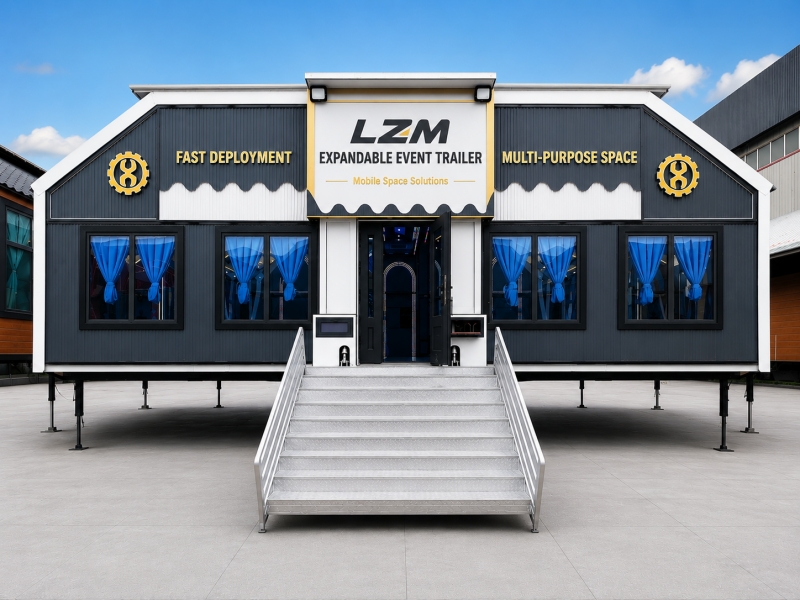
A temporary venue designed for corporate hospitality has different priorities from a high-capacity public hall.
The objective is not necessarily to accommodate the maximum possible number of people.
Instead, the operator may need to create an environment for:
Customer reception
VIP hospitality
Business networking
Sponsor guests
Product presentations
Partner meetings
Media activities
Corporate entertainment
This changes the interior design.
Comfort, presentation and flexibility may be more valuable than maximum seating density.
Many commercial event businesses do not operate from one permanent venue.
Their customers determine the location.
A rental company may serve:
São Paulo → Rio de Janeiro → Curitiba → Belo Horizonte → Another Event Location
Temporary structures and equipment need to follow that event calendar.
An expandable event trailer turns part of the venue infrastructure into a reusable mobile asset.
Instead of purchasing temporary materials for every project, the operator can repeatedly deploy the same core venue.
For companies with sufficient annual utilization, this creates a different commercial model from building event space from zero for each customer.
São Paulo is particularly relevant because event demand is not limited to one industry.
Potential applications can include:
Trade exhibitions
Automotive events
Corporate launches
Sponsor activations
Business conferences
Sports hospitality
Private corporate events
A flexible trailer can therefore be designed around several commercial applications rather than one highly specialized use.
This matters for rental companies.
The more types of profitable bookings an asset can serve, the easier it may be to improve annual utilization.
Large sports events create several temporary-space requirements simultaneously.
Sponsors may need somewhere to receive customers.
Corporate partners may require hospitality.
Event organizers may need premium guest facilities.
Brands may also want activation and promotional areas.
An expandable event trailer can potentially support a combination such as:
Guest Reception + Sponsor Branding + Lounge + Digital Content + Meeting Space
This differs from a public fan activation designed for maximum visitor throughput.
The hospitality layout focuses on selected guests and higher-value interactions.
Motorsport provides a natural environment for relocatable hospitality.
The event itself may involve temporary:
Sponsor areas
Team facilities
Media infrastructure
Customer hospitality
Product displays
An expandable event trailer can become part of this temporary event ecosystem.
After one event, it can retract and move to another commercial project.
For automotive brands and sponsors, the same venue can potentially support both corporate hospitality and brand presentation.
An exhibition booth is designed primarily to attract and engage visitors.
But exhibitors sometimes need a second type of environment.
Important customers, distributors or partners may require:
Private meetings
Product presentations
Hospitality
Negotiations
Networking
Where the event site and organizer permit, a mobile hospitality facility can provide additional controlled space outside or alongside the main exhibition environment.
This allows the public-facing booth and private business functions to remain separate.
Launching a premium product in an open outdoor environment can create problems.
Weather, noise and surrounding activity can interfere with presentations.
An enclosed expandable venue can provide a more controlled environment for:
Digital presentations
Customer reception
Product explanation
Media activities
Business meetings
The exterior can carry campaign branding while the interior provides the formal customer experience.
This is particularly useful for touring product launches that need a consistent environment in several cities.
Corporate hospitality works best when the layout reflects how guests actually use the venue.
A possible configuration might be:
Entrance
↓
Reception / Check-In
↓
Main Hospitality Lounge
↓
Presentation Area
↓
Private Meeting Space
This is only one example.
A sports hospitality project may require more lounge space.
A product launch may prioritize the presentation area.
A business event may require several meeting zones.
The layout should therefore be developed around the commercial objective.
Guest capacity figures can be misleading for hospitality applications.
A venue that accommodates a large number of theater-style chairs may hold far fewer guests when equipped with:
Sofas
Lounge chairs
Coffee tables
Meeting tables
Refreshment counters
That is not necessarily a disadvantage.
Corporate hospitality often earns value from the quality of the guest experience, not from maximum occupancy.
Buyers should therefore specify the intended furniture before evaluating practical capacity.

A fully open venue is not always ideal.
Corporate events often involve discussions that should take place away from the main hospitality area.
Depending on the project, the trailer can include separated areas for:
Executive meetings
Customer discussions
Distributor meetings
Media interviews
Partner negotiations
These spaces may accommodate relatively few people but can significantly increase the usefulness of the venue for B2B events.
Digital displays make the same physical venue easier to adapt.
At a sports event, screens may show competition coverage and sponsor content.
At a corporate event, they may display presentations.
During a product launch, they can show product videos.
At another event, completely different content can be loaded.
This reduces dependence on permanent physical decoration.
For rental operators serving different customers, digital flexibility supports faster rebranding.
A rental company's trailer should not permanently look like one customer's venue.
Changeable exterior branding can allow the asset to support different projects.
Depending on the project design, this may include:
Graphic panels
Promotional graphics
Sponsor identity
Event branding
Product imagery
The interior can follow the same principle.
A relatively adaptable base design allows furniture, graphics and digital content to create a different appearance for each booking.
Brazil covers a large geographic area and operating conditions vary considerably.
For many events, however, heat and humidity can make indoor climate control a major requirement.
HVAC sizing should consider:
Trailer dimensions
Expanded interior volume
Number of guests
Number of staff
Outdoor temperature
Humidity
LED screens
Lighting
Door-opening frequency
A premium hospitality venue needs to remain comfortable when occupied, not simply when demonstrated empty.
This means HVAC should be specified around realistic event conditions.
Climate should influence more than HVAC capacity.
For projects expected to operate regularly in humid environments, buyers should also discuss appropriate materials and protection for the expected conditions.
Relevant areas may include:
Structural components
Interior materials
Electrical equipment
Hardware
Exterior interfaces
The correct specification depends on the actual operating and storage environment.
This should be defined before production rather than addressed only after the trailer arrives.
An enclosed venue offers an important advantage during unpredictable weather, but only if the building envelope performs correctly.
Expandable structures contain moving interfaces.
Attention should therefore be given to:
Roof drainage
Expansion joints
Door sealing
Exterior interfaces
Water management
For a commercial rental company, weather protection is not simply a technical feature.
It can affect whether an event can continue as planned.
International buyers need to specify destination electrical requirements during the technical stage.
The equipment list may include:
HVAC
LED screens
Lighting
Audio equipment
Computers
Refrigeration
Network equipment
The total expected load should be calculated before production.
Electrical configuration should then be developed according to the project's destination requirements and intended equipment.
A permanent convention center may provide substantial electrical infrastructure.
An outdoor event site may not.
Rental operators should therefore understand the power requirements of their own trailer and confirm utility availability before each booking.
Where suitable site power is unavailable, an appropriately specified independent power solution may be required.
This becomes particularly important when the trailer includes high-capacity HVAC and large digital displays.
A customer may request the trailer for an impressive event location.
That does not automatically mean the site is suitable.
Before confirming a booking, the operator should check:
Road access
Trailer maneuvering
Ground conditions
Final positioning
Expanded footprint
Guest entrance
Service access
Utility connections
Emergency access
For large expandable models, this site survey can prevent major operational problems on event day.
Some buyers expect the trailer to move only several times per year.
Others may relocate it every few weeks.
Those two business models place different demands on the equipment.
Frequent relocation increases the importance of:
Deployment efficiency
Retraction procedures
Equipment security
Furniture storage
Component durability
Routine inspection
A rental company planning a busy touring schedule should explain that operating model to the manufacturer.
Purchase price is only one part of the investment decision.
A commercial operator should estimate:
How many days per year can this trailer realistically be rented?
For example, the same asset may serve:
Sports Hospitality
then:
Corporate Launch
then:
Trade Exhibition
then:
Private Business Event
then:
Brand Activation
This is why a flexible base configuration can be valuable.
The trailer does not need to be optimized perfectly for every possible application.
It needs to perform well across the applications that actually generate revenue in the operator's market.
Rental companies can also sell more than floor space.
A complete package may include:
Expandable Venue + HVAC + Lighting + LED Displays + Furniture + Branding
Additional event-production services can then be provided separately or through partners.
This changes the commercial position of the supplier.
Instead of competing only as an equipment rental business, the company can potentially offer a more complete temporary hospitality solution.
A large 21m expandable trailer creates substantial indoor space.
But it also requires suitable:
Event sites
Transportation
Deployment area
HVAC capacity
Electrical supply
A smaller configuration may be more practical for an operator serving many different locations.
The correct model depends on the expected relationship between:
Event Size + Site Availability + Rental Rate + Booking Frequency
Model selection should therefore follow the business plan.
Before selecting the final expandable event trailer configuration, the buyer should provide:
Primary event applications
Target guest capacity
Preferred furniture
Lounge requirements
Meeting-space requirements
LED display requirements
Branding strategy
HVAC requirements
Electrical equipment
Typical event locations
Expected relocation frequency
Storage conditions
Transportation, road requirements, electrical systems, accessibility, fire safety, public occupancy, event permissions and other applicable Brazilian and local requirements should be evaluated according to the actual project and deployment locations.
Corporate hospitality is temporary by nature.
The event finishes.
The guests leave.
The branding changes.
But the infrastructure does not necessarily need to disappear with every project.
An expandable event trailer allows the operator to retain the core venue and redeploy it for the next customer.
For Brazilian event production companies, rental businesses and corporate-event providers, that creates a simple commercial proposition:
one mobile venue, multiple events, multiple customers and multiple locations.
LZM manufactures expandable event trailers with customizable interior layouts, HVAC, LED display provisions, lighting, electrical systems and branding options for corporate hospitality, sports events, product launches and other commercial applications.
Explore LZM expandable event trailer models for corporate hospitality and event rental projects:
Expandable Event Trailer for Corporate Hospitality