Welcome: Laizhou Machinery Group



For caravan dealers, selecting a model is not simply a question of whether customers like the interior.
The model needs to occupy a clear position within the dealer's product range.
A 21ft off road caravan typically sits toward the larger end of a touring range and can be particularly relevant to buyers looking for:
Family accommodation
More permanent sleeping space
Bathroom facilities
Larger kitchens
Additional storage
Greater water capacity
More comprehensive off-grid equipment
However, adding more equipment does not automatically create a better 21ft caravan.
For dealers and importers, the key is balancing space, weight, payload, equipment and retail positioning.
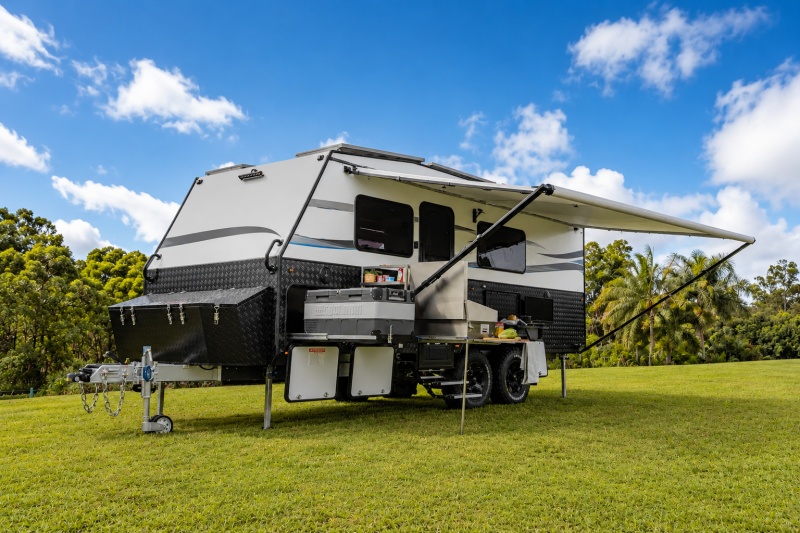
A dealer may eventually offer several caravan sizes.
Smaller caravans can appeal to couples or customers prioritizing easier towing and compact dimensions.
Mid-size models can balance interior space with overall size.
A 21ft platform can then serve customers looking for a more complete family touring setup.
This creates a clearer product ladder:
Compact → Mid-Size → 21ft Family Model
For distributors, this positioning can be more useful than offering several models with similar dimensions and almost identical customer profiles.
A 21ft model may be suitable for customers such as:
Couples wanting additional living space
Families with children
Long-distance travellers
Customers requiring more storage
Buyers planning longer off-grid stays
The exact target customer depends on the interior configuration.
For dealers, identifying this customer before specifying the caravan helps avoid unnecessary equipment.
Sleeping capacity is one of the first decisions.
A 21ft caravan does not necessarily need to maximize the number of beds.
A two-person configuration may use the available space for:
Larger main bed
More storage
Larger bathroom
Additional seating
A four-berth configuration may instead use:
Bunk beds
Convertible seating
Additional sleeping arrangements
For family-oriented dealer ranges, 4 berth configurations can provide a clear distinction from smaller couples' caravans.
For families with children, bunk beds can provide additional sleeping capacity without using the floor area required by two conventional beds.
But dealers should consider more than the number of sleeping positions.
Important factors include:
Bunk dimensions
Access
Guarding
Lighting
Ventilation
Nearby charging points
Storage
A practical family layout needs to work during both daytime and sleeping hours.
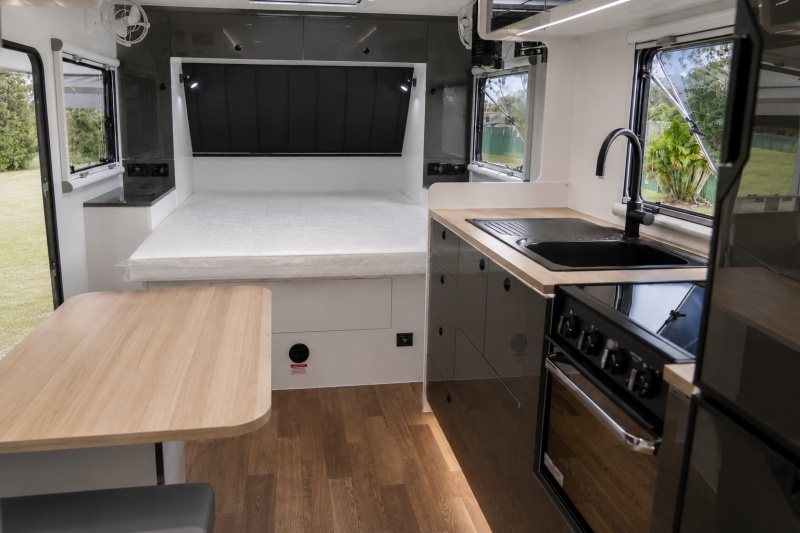
A permanent main bed offers convenience.
Customers do not need to convert the dining area every night.
However, fixed beds consume permanent interior space.
Convertible beds can improve daytime flexibility but require additional setup.
For dealer programs, it may be useful to maintain a standardized family layout rather than allowing every retail customer to redesign the sleeping arrangement.
That makes repeat production easier.
A 21ft caravan provides more room for kitchen equipment, but that does not mean every available appliance should be installed.
Possible equipment can include:
Refrigerator
Sink
Cooking equipment
Microwave
Storage
Work surface
Dealers should think about how customers actually travel.
Customers who frequently cook outdoors may value a different configuration from families who regularly prepare meals inside the caravan.
A family caravan often benefits from an integrated bathroom.
Possible configurations may include:
Toilet and shower combination
Separate shower area
Wash basin
Storage
Increasing bathroom size improves comfort but reduces the space available for other functions.
This creates a design trade-off between:
bathroom + kitchen + beds + dining + storage
The best layout depends on the dealer's target customer.
Families travelling for longer periods carry more equipment.
Storage may be required for:
Clothing
Bedding
Food
Cooking equipment
Outdoor furniture
Camping equipment
Tools
Personal items
A 21ft caravan provides opportunities for:
Overhead cabinets
Under-bed storage
Wardrobes
Kitchen storage
External compartments
But physical storage volume should never be confused with available payload.
A larger caravan can accumulate weight quickly.
Major contributors may include:
Batteries
Solar equipment
Freshwater
Spare wheels
Air conditioning
Appliances
Furniture
Customer luggage
Water is particularly easy to underestimate.
One litre of water has a mass of approximately one kilogram.
A 200-litre freshwater capacity can therefore represent roughly 200 kg of water when full.
For dealers, the final configuration should be considered as a complete weight system.
A family-oriented caravan often has greater electrical demand than a compact model.
Customers may use:
Refrigerator
Lighting
Water pump
Phones and tablets
Television
Cooking equipment
Air conditioning, depending on configuration
This can justify a larger battery system.
However, simply specifying the largest possible battery bank is not always the best approach.
Battery capacity should be coordinated with:
Daily consumption
Solar generation
Vehicle charging
Mains charging
Inverter capacity
Solar panels can extend off-grid capability, but panel capacity should be selected together with the battery and expected loads.
A dealer should consider:
generation + storage + consumption
as one system.
This is particularly important when marketing a 21ft caravan as an off-grid family model.
Customers may otherwise assume that a large battery and solar specification provides unlimited electricity.
Longer trips and more occupants can increase water demand.
Dealers may therefore request larger tanks.
The appropriate capacity depends on:
Number of occupants
Trip duration
Shower use
Cooking
Availability of refill points
Larger tanks provide greater independence but also increase loaded mass.
Tank location can additionally affect weight distribution.
A 21ft off road caravan requires more than simply installing an aggressive-looking suspension system.
The running configuration should consider:
Final caravan mass
Axle configuration
Intended road conditions
Ground clearance
Wheels and tyres
Dealer upgrades to batteries, water capacity and other heavy equipment should therefore be considered before the final running specification is confirmed.
For a dealer, replacement availability matters.
An unusual wheel or tyre specification may create after-sales problems if customers cannot easily obtain replacements.
The selected specification should balance:
Load requirements
Terrain
Caravan configuration
Local replacement availability
This is particularly relevant for caravans intended for remote travel.
A 21ft caravan may be sold into very different climates.
Dealers should therefore avoid treating climate-control equipment as a universal package.
Depending on the destination market, priorities may include:
Air conditioning
Heating
Insulation
Ventilation
Cold-weather plumbing protection
This is one area where OEM configuration can provide useful market differentiation.
For dealers, one practical strategy is to develop two versions around the same 21ft platform.
Focused on the core features required by the target customer.
This helps maintain a more accessible retail price.
May add equipment such as:
Larger lithium battery capacity
Additional solar
Higher inverter capacity
Increased water storage
Selected premium appliances
Additional accessories
Using the same basic caravan platform can reduce production complexity while creating two retail price levels.
More features can make a specification sheet look impressive.
But every additional feature can increase:
Purchase cost
Weight
Maintenance
Spare-parts requirements
Electrical demand
Production complexity
Dealers should ask:
Will this feature help us sell the caravan, or are we adding it simply because the factory offers it?
That question can prevent unnecessary specification inflation.
For wholesale projects, the 21ft platform can be discussed with dealer-specific requirements.
Depending on the project, these may include:
Exterior branding
Model designation
Interior colours
Upholstery
Equipment package
Selected appliances
Dealer documentation
The objective should be to create a recognizable local product while maintaining a repeatable manufacturing specification.
The first caravan is only one unit.
If the model sells successfully, the dealer needs the next batch to remain consistent.
Repeatability can simplify:
Marketing
Spare parts
Staff training
Warranty support
Customer expectations
This is why OEM customization should be controlled.
A successful dealer product does not need to be redesigned every time another order is placed.
Before selecting a 21ft model for wholesale purchasing, ask:
What is the intended sleeping capacity?
Which family layout is available?
What storage is included?
What is the caravan's weight configuration?
How much payload remains after options are added?
What freshwater capacity is available?
What battery capacities can be specified?
What solar options are available?
What suspension is used?
What wheels and tyres are specified?
Which appliances are standard?
Which equipment is optional?
Can dealer branding be added?
Can the same configuration be reproduced for repeat orders?
What spare parts should the dealer stock?
These questions help determine whether the caravan is suitable as a commercial dealer product, not merely whether the sample looks attractive.
Dealers and importers evaluating a larger family model can review the LZM 21ft Off Road Caravan.
The platform can be discussed according to dealer requirements for interior configuration, electrical systems, water capacity and selected OEM equipment.
For businesses developing a broader product range, LZM also supplies Wholesale Off Road Caravans from China for international dealer and importer programs.
For a dealer evaluating a 21ft caravan, useful information includes:
Sales country
Target customer
Required sleeping capacity
Preferred layout
Battery capacity
Solar requirements
Water capacity
Climate-control requirements
OEM branding
Initial purchasing quantity
Expected repeat-order volume
This allows the specification to be developed around the intended retail product rather than simply adding every available factory option.
A 21ft off road caravan can be an important family model within a dealer's product range, but its commercial value depends on more than interior size.
Sleeping capacity, payload, water, batteries, solar, suspension, storage and OEM equipment all need to be balanced within one repeatable specification.
For dealers and importers, the objective should not be to build the most heavily equipped 21ft caravan possible.
It should be to develop a clear, saleable and repeatable family model that fills a defined position within the dealer's range.