Welcome: Laizhou Machinery Group



One of the first things buyers notice about an expandable event trailer is the transformation.
On the road, it has a relatively compact transport profile.
At the event site, the side sections expand outward to create a much larger indoor venue.
That transformation naturally creates several buyer questions:
How is the trailer actually deployed?
How many people are needed?
How long does setup take?
What needs to be prepared before expansion begins?
Can the trailer arrive in the morning and host an event the same day?
The answers depend on the trailer model, configuration, site conditions, utilities, interior equipment, and the amount of event preparation required.
Understanding the complete deployment process is therefore important before purchasing an expandable event trailer.
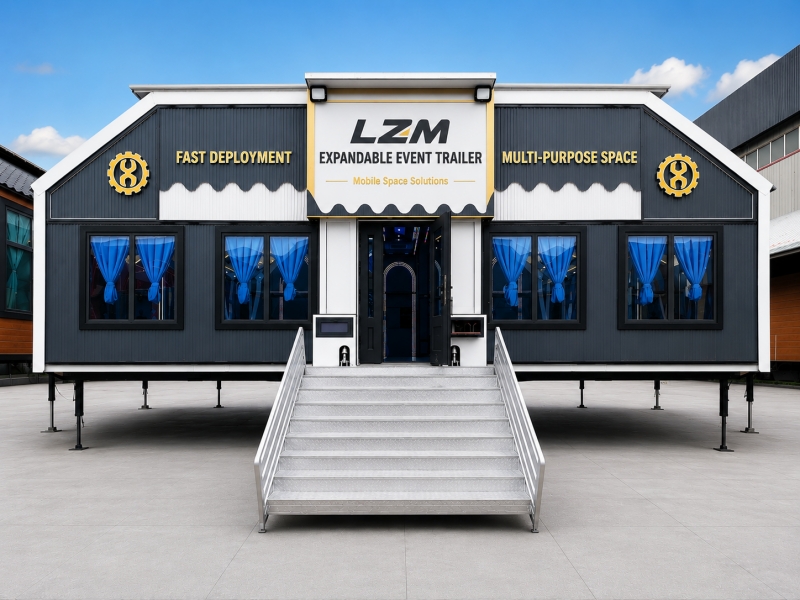
It is easy to think of setup as simply pressing a button and expanding the trailer.
In practice, the process begins earlier.
Before deployment, the operator needs to confirm that the trailer is correctly positioned on the prepared site.
Typical preliminary considerations include:
Final trailer position
Ground conditions
Available expansion clearance
Trailer level
Supporting positions
Entrance orientation
Emergency-exit clearance
Utility locations
Surrounding obstacles
The trailer should not begin expanding until the operator has confirmed that the deployment area is suitable.
Hydraulic expansion is one stage of setup—not the entire setup process.
The first task is getting the trailer into its final operating position.
This can sometimes require more planning than buyers expect.
A large expandable event trailer may need sufficient room for the transport vehicle to:
Enter the site
Turn
Reverse
Align the trailer
Reach the correct position
Disconnect where applicable
Leave the operating area
The longer the trailer, the more important vehicle maneuvering becomes.
For large models, the site should therefore be evaluated before delivery rather than for the first time when the trailer arrives.
Once positioned, the operator needs to confirm that the trailer is appropriately supported and leveled according to the equipment design and operating procedures.
Ground conditions can affect:
Structural stability
Expansion alignment
Floor alignment
Door operation
Interior comfort
Support loads
A hard, level surface generally simplifies deployment.
Sites involving soft ground, significant slopes, or uncertain bearing capacity may require additional preparation or engineering evaluation.
The hydraulic system should not be treated as a substitute for proper site preparation.
Expandable trailers use support systems according to their structural design.
These supports help stabilize the unit during deployment and operation.
Before operating the expansion system, the operator should confirm that support locations are clear and suitable.
This means checking for:
Soft ground
Drainage channels
Underground structures
Curbs
Obstacles
Uneven surfaces
Where additional load-distribution measures are required, these should be prepared according to the project conditions and operating instructions.
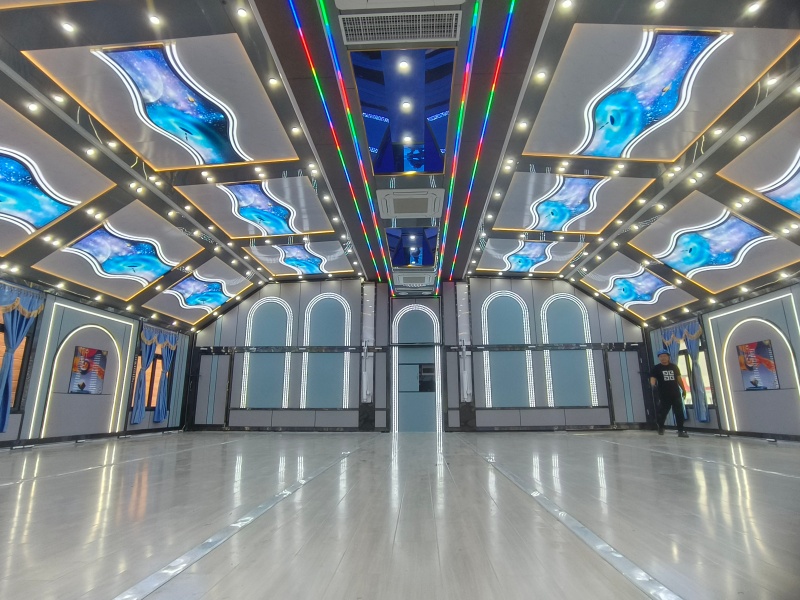
The side sections require substantial clearance when they move outward.
Before expansion, nobody should assume that an apparently empty area is automatically safe.
The operator should check for:
People
Vehicles
Temporary barriers
Furniture
Trees
Poles
Walls
Other structures
Equipment
Overhead or adjacent obstacles
The required exclusion area depends on the specific model and expansion mechanism.
Nobody should remain in an unsafe position around moving structural components during deployment.
Operators should follow the manufacturer's operating procedures and safety instructions.
Once the unit has been positioned, supported, and checked, the expandable sections can be deployed according to the specific operating procedure.
Depending on the model, the hydraulic system may control several movements involved in transforming the trailer.
The exact operating sequence is determined by the trailer design.
This is important because expandable structures should not be operated by improvising the order of movements.
Operators need to understand:
which component moves first, which follows, and when each stage is considered complete.
Training and operating instructions should therefore form part of the handover process.
The hydraulic system provides the force required to move heavy structural sections that would be impractical to deploy manually.
Depending on the trailer design, hydraulic functions can be involved in operations such as:
Side expansion
Floor movement
Roof or structural movement
Support mechanisms
The system is designed to transform the compact transport configuration into the larger operating configuration.
But hydraulic automation does not mean the entire event venue becomes operational without human involvement.
After structural deployment, additional work may still be required.
Once the structural sections are deployed, the interior should be inspected before furniture and guests are introduced.
The operator may need to confirm:
Floor alignment
Interior joints
Wall positions
Door operation
Ceiling condition
Lighting
Electrical systems
Interior finishes
Any components that require manual positioning or securing according to the particular configuration should also be completed.
The objective is to verify that the facility has moved correctly from transport condition to operating condition.
The venue now needs its operating services.
Depending on the project, these may include:
Main electrical supply
Generator
HVAC
Internet
Water
Wastewater
External lighting
AV equipment
Electrical requirements can be substantial.
An event trailer containing air conditioning, LED screens, professional lighting, sound equipment, catering equipment, or other high-load systems needs an appropriately designed power supply.
Buyers should know the expected electrical load before arriving at an event site.
Climate control takes time to condition a large interior.
In hot or cold environments, waiting until guests enter before switching on HVAC may result in an uncomfortable start to the event.
Operators should incorporate climate conditioning into the setup schedule.
The required time depends on factors including:
Interior volume
Outdoor temperature
HVAC capacity
Number of doors open during setup
Equipment operating inside
Desired indoor temperature
For extreme climates, this becomes an important operational consideration.
The structural venue may now be ready, but the event itself is not.
Depending on the application, the operator may still need to arrange:
Tables
Chairs
Stage
Dance floor
LED screens
Sound equipment
Lighting
Decorations
Exhibition equipment
Registration desks
Catering equipment
This is why trailer deployment time and complete event setup time are not the same thing.
A buyer should distinguish between:
Structural Deployment
and
Event Preparation.
The second can take much longer depending on the event.
There is no responsible universal answer such as “two people” or “four people” for every expandable event trailer project.
Staffing depends on:
Trailer model
Final configuration
Site conditions
Equipment
Furniture
Event type
Local operating requirements
The personnel operating the expandable structure also do not necessarily perform every other setup task.
A wedding production, for example, may involve separate teams for:
Trailer operation
Furniture
Decoration
Audio
Lighting
Catering
Therefore, buyers should distinguish between personnel required to deploy the trailer and the total event setup crew.
This is another question where a single universal number can be misleading.
Several different times are involved:
Positioning Time
Getting the trailer into the correct location.
Structural Deployment Time
Supporting and expanding the trailer.
Utility Connection Time
Connecting electricity and other required services.
Interior Preparation Time
Arranging furniture and equipment.
Event Production Time
Installing decoration, AV systems, catering, stage equipment, and other event-specific elements.
A simple conference configuration and a high-end wedding production can use the same expandable trailer while requiring very different total preparation times.
Ask the manufacturer about the deployment procedure for the specific model, but build the event schedule around the complete operation.
Potentially, depending on the project.
But this should not automatically become the standard operating plan.
Same-day arrival may create unnecessary risk if there are problems involving:
Traffic delays
Site access
Ground conditions
Utilities
Weather
Equipment installation
Technical testing
For important events, operators may prefer to deploy sufficiently early to allow inspection and preparation before guests arrive.
A wedding, major corporate event, or live production should not depend on an unrealistically tight setup schedule simply because the trailer itself is mobile.
A trailer that moves several times each month has different operational priorities from one that remains deployed at a resort for six months.
Frequent-movement operators should pay particular attention to:
Setup efficiency
Furniture storage
Equipment securing
Cable management
Quick-connect systems
Staff training
Transport preparation
Maintenance
Every manual task repeated during each deployment adds labor and time.
For a rental company, deployment efficiency can directly affect operating cost and the number of events the asset can serve.
A common design mistake is creating a beautiful interior without considering what happens when the trailer closes.
Furniture and equipment may need to be:
Fixed
Folded
Removed
Secured
Stored
before transport.
For example, a large banquet configuration may contain dozens of tables and chairs.
The operator needs a plan for those items when the trailer is retracted.
Will they remain inside?
Will they travel in another vehicle?
Where will they be stored?
These decisions influence both interior design and operating logistics.
After an event, the venue needs to return to transport condition.
Before retraction, the operator should confirm that all items affected by the moving sections have been removed, folded, secured, or placed in their designated transport positions.
The general process may involve:
Remove Event Equipment → Disconnect or Secure Utilities → Prepare Interior → Inspect Moving Areas → Retract Structure → Secure for Transport
The exact sequence must follow the operating instructions for the specific trailer.
Rushing this process can damage interior equipment or structural components.
The interior is not the only area that needs checking before departure.
The operator may also need to remove or secure:
Entrance stairs
Ramps
External signage
Decorative structures
Utility cables
Water connections
External lighting
Temporary barriers
Other site equipment
A departure checklist can help prevent equipment from being left behind or damaged.
Before the trailer returns to the road, the operator should verify that it is fully returned to the intended transport configuration.
The inspection should follow the manufacturer's procedures and applicable transport requirements.
Items requiring attention may include:
Expandable sections
Locks and securing mechanisms
Doors
External equipment
Support systems
Electrical connections
Lights
Tires
Coupling
Braking-related systems
Overall transport condition
For frequently moved rental equipment, documenting this procedure as a standard checklist can improve operational consistency.
Hydraulic systems and moving structural components need appropriate inspection and maintenance.
A trailer that spends most of its life stationary has a different operating profile from one deployed and retracted dozens of times each year.
Maintenance planning may include inspection of relevant:
Hydraulic components
Hoses
Connections
Seals
Moving mechanisms
Structural components
Electrical systems
Support systems
The exact maintenance schedule should follow the equipment design, operating conditions, and manufacturer recommendations.
A sophisticated expandable trailer should not depend on one employee who is the only person who knows how to operate it.
Commercial operators should consider training multiple staff members.
They should understand:
Site inspection
Positioning requirements
Deployment sequence
Safety zones
Utility connections
Basic troubleshooting
Pack-down procedure
Pre-transport inspection
For rental businesses operating many events, standardized operating procedures can become particularly important.
Before purchasing an expandable event trailer, ask the manufacturer:
1. What is the deployment sequence for this model?
2. Which movements are hydraulic and which require manual work?
3. What site conditions are required before deployment?
4. What supporting and leveling procedures are required?
5. What clearance is needed during expansion?
6. What electrical supply is required for operation?
7. Which interior items must be moved before expansion or retraction?
8. How should furniture be stored during transport?
9. What operator training is provided?
10. What inspections are required before transportation?
11. What routine maintenance does the hydraulic system require?
12. Which spare parts should a commercial operator keep available?
These questions provide a much better understanding of real operating requirements than watching a short expansion video alone.
Expandable event trailers are often marketed through their most dramatic feature:
a compact trailer becomes a large indoor venue.
But professional buyers should evaluate what happens before and after that transformation.
The real operating cycle is:
Transport → Position → Support → Expand → Inspect → Connect Utilities → Prepare Event → Operate → Pack Down → Retract → Inspect → Transport Again
For a venue that moves only occasionally, several additional setup tasks may have little commercial impact.
For an event rental company relocating frequently, however, every repeated step affects labor, scheduling, transport cost, turnaround time, and ultimately profitability.
That is why deployment procedure should be evaluated alongside size, capacity, interior design, and purchase price when selecting an expandable event trailer.
LZM develops expandable event trailers according to venue capacity, deployment requirements, interior configuration, hydraulic systems, electrical requirements, transportation conditions, and individual commercial applications.
See the expandable event trailer platform and discuss the deployment configuration for your project:
Expandable Event Trailer Setup & Deployment Solutions