Welcome: Laizhou Machinery Group



Modern off road caravans depend heavily on electrical systems.
Lighting, water pumps, refrigerators, battery monitoring, solar charging, USB outlets, kitchen appliances and air conditioning can all depend on the caravan's electrical architecture.
For Australian caravan dealers developing an OEM product, specifying a large lithium battery and several solar panels is therefore only part of the job.
The complete system may need to coordinate:
12V DC equipment
240V AC equipment
Lithium batteries
Solar charging
Vehicle charging
Mains charging
Inverter
Distribution and circuit protection
The objective should be a coordinated electrical system rather than a collection of individually upgraded components.
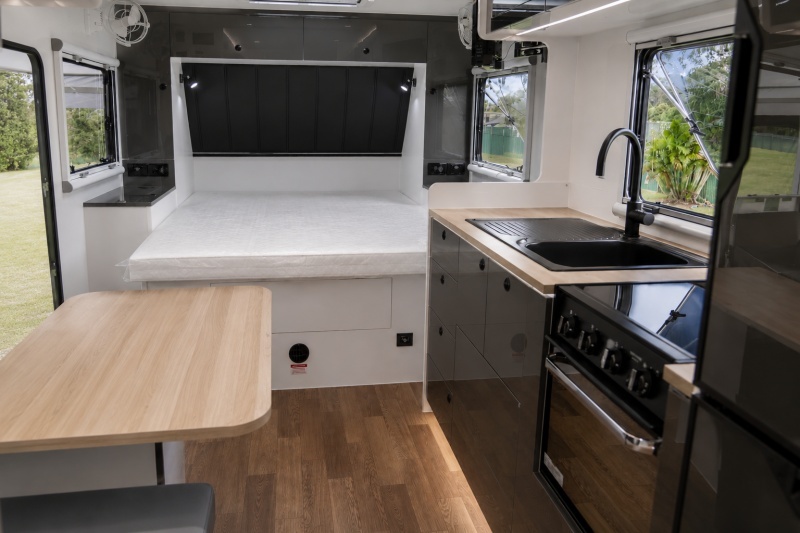
The 12V system commonly supports lower-voltage caravan equipment.
Depending on the configuration, this may include:
LED lighting
Water pumps
Control equipment
USB charging
Ventilation fans
Refrigeration equipment
Monitoring systems
Other DC appliances
For off-grid travel, many of these systems operate directly from the caravan battery bank.
This makes battery capacity and daily DC consumption closely related.
Australian caravan projects may also include 240V AC equipment.
Depending on the specification, this can include:
General power outlets
Kitchen appliances
Air conditioning
Battery chargers
Other AC equipment
When the caravan is connected to an appropriate external power source, the AC system can supply compatible equipment according to the installed electrical configuration.
When external power is unavailable, selected AC loads may potentially be supplied through an inverter, depending on system design.
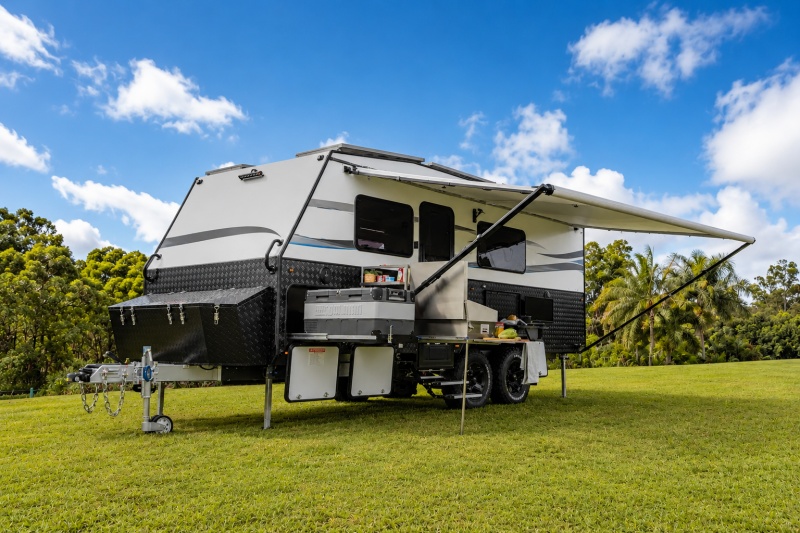
An inverter converts DC battery power into AC electricity for compatible equipment.
Dealers sometimes focus only on the inverter's advertised power rating.
But inverter selection should also consider:
Expected appliance load
Battery capacity
Peak demand
Cable sizing
Protection
Installation
Charging capability
A large inverter combined with an inadequate battery and wiring system does not create a well-designed electrical package.
Consider equipment such as:
Air conditioner
Microwave
Induction cooker
Coffee machine
Hair dryer
These can require substantially more power than LED lights or a water pump.
If dealers want customers to operate high-power appliances from batteries, the electrical specification may need changes to:
battery bank → inverter → cabling → protection → charging capacity
This should be planned before production.
A caravan with a large lithium battery bank may appear impressive in a specification sheet.
But actual off-grid capability depends on both:
energy storage and energy consumption.
A larger battery can provide more stored energy, but customers may also have greater electrical demand from:
Air conditioning
Refrigeration
Cooking
Entertainment equipment
Electronics
For this reason, dealers should define the intended usage before selecting the electrical package.
Depending on the caravan configuration, battery charging may involve:
Solar panels
External mains power
Tow vehicle charging
Other compatible charging sources
Each source requires appropriate charging equipment and electrical coordination.
A dealer developing an OEM product should therefore define how customers are expected to recharge the battery system during normal travel.
Installing a large battery bank without sufficient charging capacity can create a different problem: the batteries may take too long to recover after heavy use.
Similarly, a large solar array cannot guarantee continuous off-grid power if customer consumption regularly exceeds available generation.
The system should balance:
Battery storage
Solar input
Vehicle charging
Mains charging
Daily consumption
This provides a more useful specification than simply maximizing one number.
Wiring is largely hidden after the caravan is completed, but it remains an important part of the product.
Electrical design needs to consider factors such as:
Current requirements
Cable sizing
Circuit routing
Connection quality
Protection
Accessibility
Higher-power equipment can require very different cabling from low-power lighting circuits.
Dealers requesting equipment upgrades should therefore confirm whether related wiring and protection also need to change.
Electrical systems require appropriate protection according to their design and applicable requirements.
Depending on the circuit, this may involve devices intended to protect against conditions such as excessive current or electrical faults.
For an OEM project, dealers should not treat protective components as optional decorative accessories.
They form part of the electrical system itself.
A beautiful installation can still create after-sales problems if technicians cannot reach important components.
Service planning should consider access to items such as:
Fuses
Distribution equipment
Chargers
Inverter
Solar controller
Battery management equipment
Electrical connections
For a dealer supporting multiple caravans, serviceability becomes increasingly important as the number of units in the market grows.
Not necessarily.
Dealers may find it more practical to develop several standardized packages.
Suitable for customers who frequently use powered campsites.
Designed around greater battery capacity, solar charging and independent operation.
Designed for customers requiring higher electrical loads and longer periods away from external power.
Standardized packages can provide customer choice while keeping production and after-sales support manageable.
Electrical requirements are a compliance issue, not simply a factory option.
An overseas manufacturer's standard electrical configuration should not automatically be assumed to satisfy Australian requirements.
For an imported commercial product, the dealer should confirm applicable requirements for areas such as:
AC electrical installation
Electrical equipment
Plugs and outlets
Protection devices
Components
Certification or approval requirements where applicable
These requirements should ideally be clarified before production, because correcting a completed electrical installation after arrival can be expensive and inefficient.
Before confirming an OEM electrical specification, dealers should ask:
Which equipment operates on 12V?
Which equipment requires 240V?
What lithium battery capacities are available?
What inverter options are available?
How much solar can be installed?
Can the caravan charge from the tow vehicle?
What mains charging equipment is used?
How are circuits protected?
How is wiring sized for higher-power equipment?
Where are electrical components installed?
Can major components be accessed for servicing?
Can locally supported components be specified?
Can the same electrical configuration be maintained for repeat orders?
Which elements require Australian compliance confirmation?
These questions help dealers evaluate the complete electrical architecture, rather than comparing only battery and solar numbers.
LZM works with caravan dealers and importers developing different electrical and off-grid configurations according to their target customers.
Battery systems, solar charging, interior equipment and other OEM requirements can be considered as part of the complete product specification.
Australian businesses evaluating manufacturing platforms can explore the LZM OEM Off Road Caravan Solutions.
A 21ft family caravan may have greater electrical demand because customers can require additional appliances, lighting, refrigeration and off-grid equipment.
For dealer projects, electrical configuration can be discussed together with:
Lithium battery capacity
Solar system
Inverter
Charging
Air conditioning
Interior appliances
Water system
Overall weight
Review the 21ft Off Road Caravan with Custom Electrical Options.
For an Australian dealer, one of the most useful ways to begin an OEM electrical discussion is to provide the equipment customers are expected to use.
For example:
Refrigerator
Air conditioner
Microwave
Induction cooker
Television
Water pump
USB charging
Other appliances
Required off-grid duration
Expected purchasing quantity
LZM can then discuss battery, solar, inverter and related equipment as one coordinated configuration rather than simply adding the largest available components.
A modern off road caravan electrical system is much more than a battery and solar panels.
12V loads, 240V equipment, batteries, inverter capacity, solar generation, charging sources, wiring and circuit protection all need to work together.
For Australian dealers, the strongest OEM specification is not necessarily the one advertising the largest battery capacity.
It is the one that matches the customer's real electrical demand, remains practical to service and can be consistently reproduced for future dealer orders.