Welcome: Laizhou Machinery Group



When dealers compare off road caravans, much of the attention goes to visible features such as suspension, tyres, ground clearance and interior equipment.
But the components connecting and controlling the caravan during towing are just as important.
For an Australian dealer or importer, the technical specification should also consider:
Braking system
Coupling
Breakaway safety system
Electrical towing connection
Safety connections
Loaded caravan mass
Tow vehicle compatibility
These systems should be evaluated according to the final caravan configuration and applicable Australian requirements, rather than selected only from a standard factory specification.
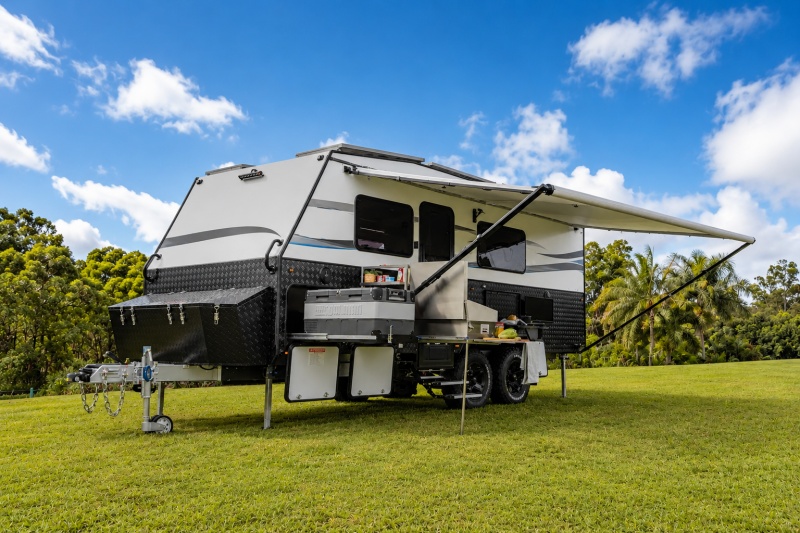
A caravan braking system cannot be evaluated independently from caravan weight.
The final configuration may include:
Lithium batteries
Solar equipment
Freshwater tanks
Air conditioning
Spare wheels
Additional storage
Customer equipment
Each addition can increase the loaded mass.
Therefore, when an OEM buyer changes the specification, the manufacturer should consider whether the braking and running configuration remains appropriate for the completed caravan.
Two 21ft caravans may look almost identical while having substantially different operating weights.
One may have a relatively simple touring configuration.
Another may contain:
Larger battery bank
Larger water capacity
More appliances
Additional spare wheel
Heavier interior equipment
This is why dealers should not select braking components merely according to caravan length.
Weight and technical requirements matter more than the number printed in the model name.
Electric braking systems are commonly associated with caravan and trailer applications in Australia.
The complete arrangement can involve interaction between:
Caravan braking components
Tow vehicle
Brake controller
Wiring
Electrical connectors
For an imported OEM caravan, the exact system needs to be specified according to the intended destination requirements and completed vehicle configuration.
Dealers should confirm these requirements before production rather than expecting incompatible components to be easily corrected after arrival.
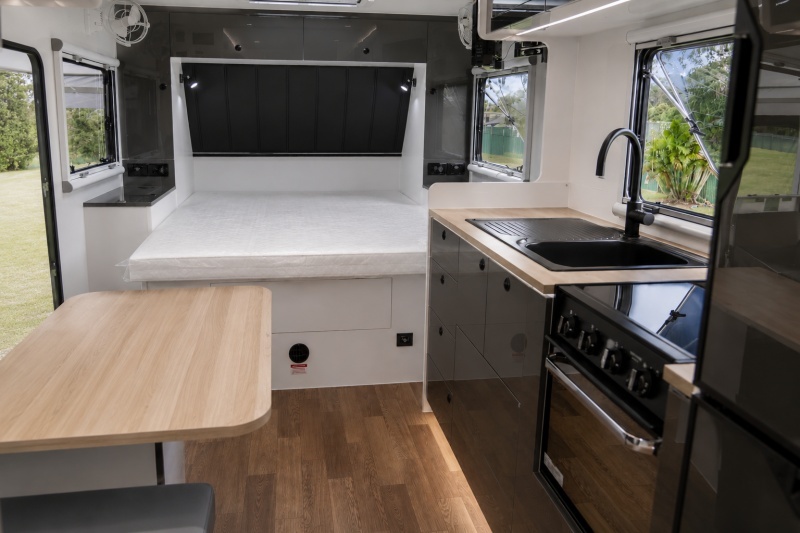
A breakaway system is intended to activate the caravan brakes if the caravan becomes unintentionally separated from the towing vehicle, subject to the design of the applicable system.
It may involve components such as:
Breakaway switch
Cable
Electrical supply
Braking system connection
For dealers, the important point is that the breakaway system should not be viewed as an isolated accessory.
It forms part of the caravan's overall towing-safety configuration.
The coupling is the physical connection between the caravan and tow vehicle.
For off road applications, buyers may pay particular attention to articulation and operation over uneven terrain.
However, dealers should not select a coupling simply because it is marketed as "off road."
Important considerations can include:
Applicable load rating
Caravan configuration
Intended terrain
Tow vehicle compatibility
Installation
Destination-market requirements
Replacement and servicing
A suitable coupling should match the actual product rather than merely provide an off road appearance.
An off road caravan may spend part of its life on rough roads but still travel substantial distances on normal highways.
The towing connection therefore needs to perform appropriately across the intended range of operating conditions.
Dealers should define whether their customers are mainly:
Highway tourers
Gravel-road travellers
Remote campers
More demanding off road users
The specification can then be discussed according to the actual customer group.
The connection between the tow vehicle and caravan may support functions such as:
Road lighting
Brake-related systems
Charging, depending on configuration
Other towing electrical functions
For an OEM project, the dealer should define the intended electrical interface before production.
Changing connectors or rewiring after arrival adds unnecessary work and can create inconsistency between units.
Some off-grid caravan customers want the battery system to charge while travelling.
This introduces another technical relationship between:
tow vehicle → charging system → caravan battery system
If vehicle charging is required, the OEM specification should consider:
Battery chemistry
Charging equipment
Electrical capacity
Cable sizing
Protection
Connection arrangement
It should not simply be added as an afterthought after the caravan electrical system has already been finalized.
Depending on the applicable towing configuration and regulatory requirements, additional safety connections may be required.
For an importer, the important principle is simple:
do not assume the exporting factory's domestic towing configuration automatically satisfies Australian requirements.
The required hardware, ratings and installation should be confirmed for the destination market.
Towing performance is also influenced by the physical relationship between the tow vehicle and caravan.
Relevant considerations may include:
Coupling height
Caravan ride height
Suspension
Tyre size
Loaded condition
This becomes particularly relevant when dealers request:
Higher suspension
Larger tyres
Increased ground clearance
Changing one specification can influence another.
That is why OEM caravan development should be approached as a complete vehicle system.
Suppose a dealer requests:
Higher ground clearance
Different suspension
Larger wheels and tyres
Those changes may alter caravan geometry.
The manufacturer may then need to reconsider related areas such as:
Coupling position
Entry height
Overall height
Underbody clearance
Towing setup
This is a good example of why customization should not mean simply adding options from a list.
For a dealer building a long-term product range, serviceability matters.
Braking and towing components may require:
Inspection
Adjustment
Maintenance
Replacement
Dealers should understand:
Component specifications
Replacement availability
Service requirements
Where appropriate, using components that can be supported in the destination market can simplify long-term after-sales service.
Before confirming an OEM caravan specification, dealers should ask:
What braking system is proposed?
What caravan weight is the system intended to support?
What coupling is specified?
What is the coupling load rating?
Is the coupling appropriate for the intended terrain?
What breakaway system is proposed?
What towing electrical connection is used?
Is vehicle-to-caravan charging required?
How do suspension and tyre changes affect coupling geometry?
Which towing components need local compliance confirmation?
Are replacement braking and coupling components available?
Can the same specification be maintained across repeat orders?
These questions should be resolved before mass production, not after the caravans arrive in Australia.
Braking, towing and safety requirements are regulatory matters.
The correct configuration depends on factors including the caravan's final specifications and applicable Australian requirements.
For commercial importers, compliance requirements should therefore be verified with the appropriate Australian authorities, engineers or compliance professionals before the order is finalized.
An overseas manufacturer's standard configuration should never be treated as automatic evidence of Australian compliance.
LZM works with caravan dealers and importers requiring different caravan configurations for their target markets.
Running systems, electrical equipment, body configuration and interior specifications can be discussed as part of the overall OEM project.
Australian dealers comparing available manufacturing platforms can review the OEM Off Road Caravan Range for Australian Dealers.
For a larger family caravan, braking and towing specifications should be considered according to the complete vehicle configuration.
Battery capacity, water storage, interior equipment and optional accessories can all affect the final loaded mass.
Dealers evaluating this size can review the LZM 21ft Off Road Family Caravan Model.
For an Australian dealer developing an OEM caravan model, useful project information includes:
Caravan size
Expected loaded weight
Target customer
Typical tow vehicle category
Intended road conditions
Suspension requirements
Wheel and tyre requirements
Required electrical system
Local compliance requirements
Expected purchasing quantity
With this information, LZM can discuss the caravan specification as a complete project rather than treating braking, coupling and suspension as unrelated components.
Off road caravan capability is not determined only by suspension travel, large tyres or ground clearance.
The braking system, coupling, breakaway arrangement, towing electrical connection and final loaded weight are fundamental parts of the complete product.
For Australian dealers, these systems deserve attention during the OEM specification stage—particularly when batteries, water tanks, suspension or other equipment are being customized.
The objective is not simply to build a caravan with more features. It is to develop a coordinated, repeatable product specification that can be appropriately assessed for the Australian market.