Welcome: Laizhou Machinery Group



An off road caravan may have a strong chassis and capable suspension, but those components alone do not determine whether the product is suitable for long-distance travel on gravel and remote roads.
For South African dealers and importers, several less visible specifications deserve attention:
Tyres
Wheels
Ground clearance
Spare-wheel arrangement
Underbody protection
Tank positioning
Plumbing protection
Replacement-part availability
These details become particularly important when customers travel far from major cities or established service facilities.
For an OEM caravan project, rugged appearance should never replace practical engineering.
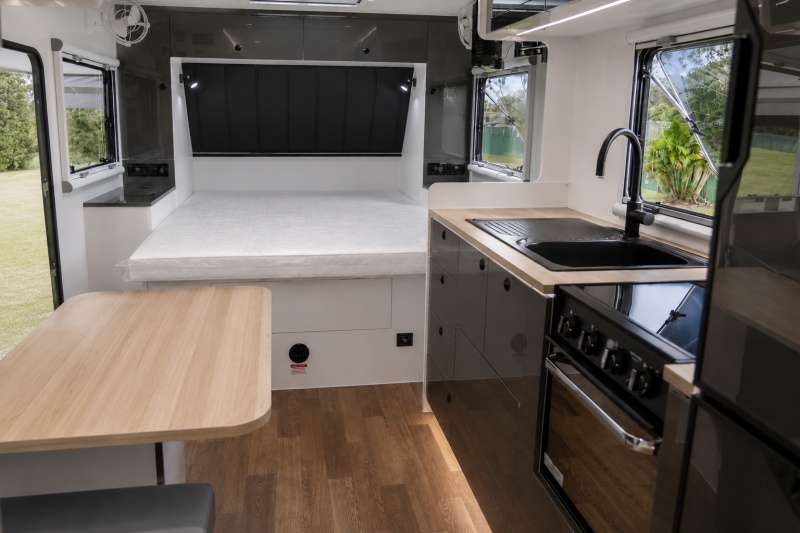
Tyres are one of the most visible features of an off road caravan.
However, appearance alone does not determine suitability.
Dealers should consider factors such as:
Tyre dimensions
Load rating
Intended road conditions
Wheel compatibility
Replacement availability
Final loaded caravan mass
The tyre specification needs to support the actual caravan configuration.
A heavily equipped family caravan with large water tanks and batteries may have different requirements from a lighter compact model.
When developing an OEM specification, dealers should know the intended loaded mass of the caravan.
Tyres should then be evaluated according to the applicable load requirements and manufacturer specifications.
This is another reason why caravan components cannot be selected independently.
Adding:
Larger batteries
More water
Additional storage
Extra appliances
changes the overall weight calculation and may influence the running-component specification.
For an importer, technical performance is only one consideration.
Imagine a customer damages a tyre during a long-distance trip and discovers that the exact replacement size is difficult to obtain locally.
That creates an unnecessary after-sales problem.
Dealers should therefore consider whether the selected tyre size is reasonably serviceable in their market.
For commercial distribution, a technically appropriate and locally supportable specification may be more valuable than an unusual tyre selected mainly for appearance.
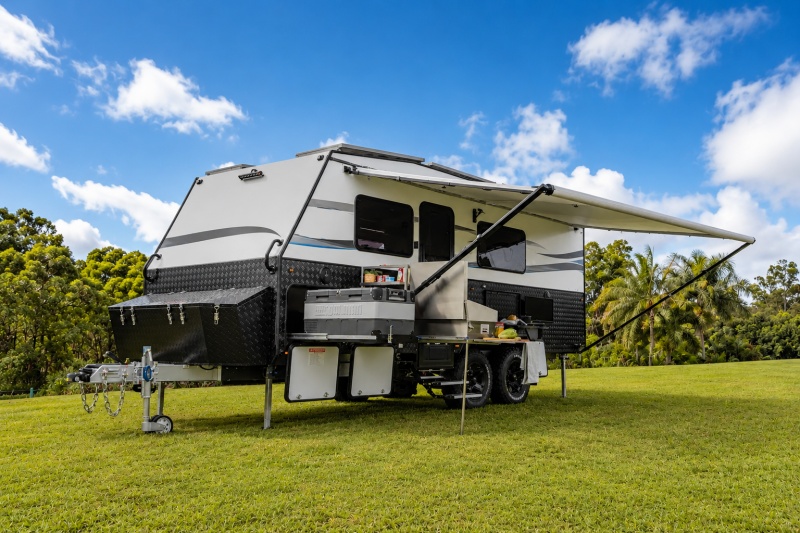
Dealers should not assume that any wheel with the correct diameter can be substituted.
Important factors can include:
Wheel dimensions
Load capacity
Bolt pattern
Offset
Tyre compatibility
Replacement requirements should be understood before a product range is established.
Keeping wheel and tyre specifications consistent across repeat production can also simplify dealer inventory and customer support.
There is no single ideal figure for every caravan.
Required clearance depends on:
Road conditions
Caravan length
Suspension
Axle position
Underbody equipment
Intended application
A caravan used mainly on highways and maintained gravel roads has different requirements from a product intended for more demanding remote routes.
More ground clearance can improve clearance over uneven terrain, but maximum height should not become the objective by itself.
Increasing caravan ride height can affect:
Centre of gravity
Entry height
Overall height
Towing behaviour
Suspension geometry
For this reason, ground clearance should be treated as part of the complete vehicle design.
Dealers should ask:
Which components actually determine the lowest point underneath the caravan?
The answer may be more useful than a single advertised ground-clearance number.
Depending on the caravan layout, equipment underneath the body may include:
Freshwater tanks
Grey-water tanks
Plumbing
Electrical wiring
Steps
Other service components
When travelling on gravel or uneven roads, these areas may be exposed to:
Stones
Dust
Water
Road debris
Physical impact
The design should consider the location and protection of vulnerable components according to the intended operating environment.
A large water tank can be valuable for remote travel, but its installation involves more than capacity.
Dealers should consider:
Tank mounting
Position
Ground clearance
Protection
Plumbing connections
Full-tank weight
For example, a 200-litre tank contains approximately 200 kg of water when full.
That weight also influences chassis loading and weight distribution.
Pipes and fittings can experience vibration during travel.
OEM design should consider:
Secure mounting
Routing
Connection protection
Accessibility
Exposure underneath the caravan
A well-protected system can reduce the risk of avoidable damage during remote travel.
For remote travel, a spare-wheel strategy deserves consideration.
Depending on the dealer's target customer, this may involve:
One spare wheel
Additional spare-wheel provision
Suitable mounting location
However, spare wheels also add weight.
Their position can affect:
Weight distribution
Rear loading
Storage
Accessibility
The solution should therefore be evaluated as part of the complete caravan specification.
There is no universal answer.
The appropriate location depends on caravan design.
Important considerations include:
Accessibility
Structural support
Ground clearance
Weight distribution
Departure geometry
Other installed equipment
A spare wheel is useful only if customers can access it practically when required.
Gravel roads can expose the front and underside of a caravan to stones thrown by the towing vehicle.
Depending on the application, dealers may want to discuss protective measures for vulnerable areas.
The required solution depends on:
Caravan construction
Towing setup
Road conditions
Position of exposed components
The goal should be functional protection rather than adding decorative "off road" components with little practical value.
Remote-road operation does not only create impact risks.
Fine dust can also reach:
Storage compartments
Service openings
Plumbing penetrations
Electrical penetrations
Underbody design should therefore be considered together with the caravan's overall sealing strategy.
This is especially important for customers who regularly travel on unsealed roads.
Before confirming an OEM specification, dealers should ask:
What tyre size is used?
What is the tyre load rating?
Is the tyre size readily replaceable in our market?
What wheel specification is used?
What is the effective ground clearance?
What is the lowest underbody point?
How are water tanks protected?
How is exposed plumbing protected?
Where is the spare wheel installed?
Can an additional spare-wheel provision be considered?
How does extra equipment affect payload?
Can the same wheel and tyre specification be maintained for future orders?
These questions provide more useful purchasing information than simply asking whether the caravan has "off road tyres."
LZM works with international dealers and importers developing caravan configurations for different road conditions and customer groups.
Tyres, suspension, water systems, electrical equipment and other specifications can be considered together during OEM development.
South African businesses evaluating different platforms can review the Off Road Caravan Range for Dealers and Importers.
For a larger family caravan, tyre and underbody planning should take the complete loaded configuration into account.
Battery systems, water capacity, storage and optional equipment all contribute to final weight.
Dealers evaluating a larger platform can review the 21ft Family Caravan for Off Road Touring.
If your business is evaluating an off road caravan range for South Africa, useful information includes:
Target customer group
Typical road conditions
Preferred caravan size
Expected loaded configuration
Water capacity
Battery system
Spare-wheel requirements
Required ground clearance
Initial purchasing quantity
LZM can discuss these requirements together rather than selecting tyres, suspension and equipment as unrelated options.
Off road capability is not created by fitting aggressive-looking tyres to a standard caravan.
For customers travelling on gravel and remote roads, tyre load capacity, local replacement availability, ground clearance, tank protection, plumbing protection and spare-wheel planning all matter.
For South African dealers, these specifications should be defined according to actual customer use and then integrated with the caravan's chassis, suspension and loaded weight.
That approach creates a more practical off road product—and a product that is easier for a dealer to support after the sale.