Welcome: Laizhou Machinery Group



Suspension, batteries and solar capacity receive considerable attention when dealers compare off road caravans.
However, another part of the caravan directly affects everyday customer comfort:
the body structure itself.
Wall and roof construction, insulation, windows, doors and sealing influence how the caravan performs in:
Hot weather
Cold weather
Wind
Rain
Dust
Changing temperatures
For Australian dealers developing an OEM caravan range, thermal performance should therefore be considered during the specification stage rather than treated as a secondary interior feature.
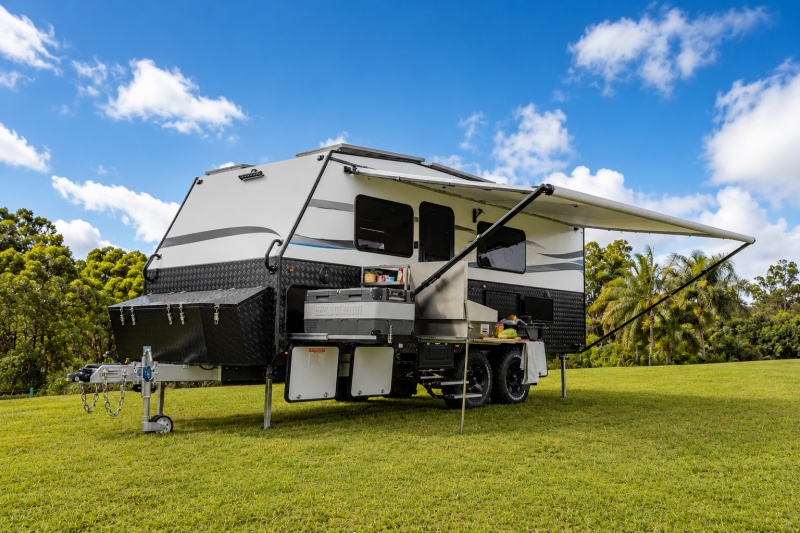
Insulation reduces heat transfer between the interior and exterior of the caravan.
In hot conditions, it helps reduce heat entering the living space.
In colder conditions, it helps retain interior heat.
This can influence:
Interior comfort
Air-conditioning demand
Heating demand
Energy consumption
Battery usage during off-grid travel
For a caravan relying heavily on battery power, thermal efficiency and electrical-system design are therefore connected.
The roof receives significant solar exposure when a caravan is parked outdoors.
Heat entering through the roof can increase the cooling load inside the caravan.
Dealers evaluating body construction should therefore consider:
Roof structure
Insulation material
Insulation thickness
Thermal bridging
Interior ceiling construction
Openings through the roof
Solar panels, air conditioners, roof vents and other equipment also create installation points that require appropriate sealing.
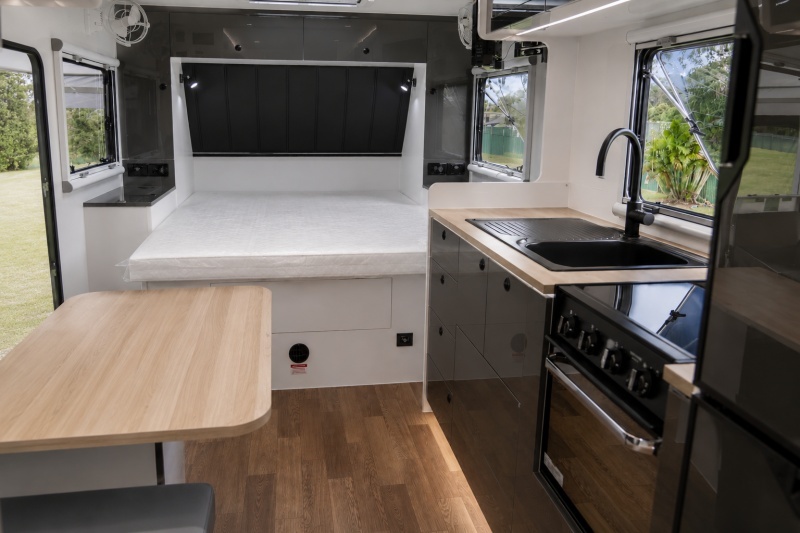
Interior finishes can make two caravans look similar even when their underlying wall structures are different.
Dealers should look beyond decorative panels and ask how the wall is constructed.
Important considerations include:
Structural layers
Insulation
Interior lining
Exterior skin
Joint construction
Moisture protection
For an OEM product, wall design should balance strength, weight, thermal performance and manufacturing consistency.
Insulation performance depends not only on the insulation material itself.
Areas where highly conductive structural components connect the exterior and interior can create paths for heat transfer.
These are often described as thermal bridges.
Their significance depends on the construction system.
For dealers comparing caravan body designs, it is therefore better to consider the complete wall and roof structure rather than judging thermal performance from insulation thickness alone.
Windows provide:
Natural light
Ventilation
Exterior views
Interior openness
But they can also affect thermal performance.
Important considerations include:
Window construction
Glass or panel type
Frame design
Sealing
Size
Shading
A caravan with very large windows may look attractive in marketing photographs but can have different heating and cooling requirements from a model with a more conservative window area.
An off road caravan may encounter:
Dust
Rain
Wind
Vibration
Repeated opening and closing
Door sealing should therefore be evaluated as part of the complete body design.
Dealers should pay attention to:
Sealing strips
Door alignment
Locking points
Threshold design
Long-term serviceability
A sophisticated electrical system cannot compensate for a poorly sealed body.
Customers travelling on unsealed roads may experience substantial dust exposure.
Potential entry points can include:
Doors
Windows
Vents
Service openings
Cable penetrations
Plumbing penetrations
Storage compartments
The objective is not simply to "make the caravan airtight."
Ventilation remains necessary.
Instead, the design should control where air enters and ensure openings and penetrations are appropriately managed for the intended application.
Condensation occurs when moisture in the air encounters a sufficiently cold surface.
Inside a caravan, moisture can come from:
Breathing
Cooking
Showering
Wet clothing
Weather conditions
Because a caravan is a relatively small enclosed space, moisture can accumulate quickly.
Condensation may appear on:
Windows
Metal surfaces
Wall areas
Corners
Other cold surfaces
Insulation helps, but insulation alone does not eliminate condensation.
A common mistake is to think that the most tightly sealed caravan automatically provides the best thermal performance.
In reality, occupants still require controlled ventilation.
A practical design should balance:
insulation + sealing + ventilation + moisture management
For example, cooking and showering can create substantial moisture.
Ventilation helps remove that moisture before it accumulates inside the caravan.
Potentially, yes.
If the caravan loses or gains heat more slowly, the heating or cooling system may need to work less to maintain a comfortable interior temperature.
This can be particularly useful during off-grid travel where electricity is supplied by:
Lithium batteries
Solar panels
Inverters
However, actual energy consumption depends on many factors, including:
Outside temperature
Caravan size
Insulation
Windows
Number of occupants
Appliance efficiency
Desired indoor temperature
Dealers should therefore avoid promising a specific battery saving based on insulation alone.
Dealers often want:
Better insulation
More batteries
More water
More storage
More equipment
But every design decision can affect:
Weight
Interior dimensions
Cost
Production complexity
This is why caravan engineering involves balancing specifications rather than maximizing every individual feature.
For caravans intended for warmer regions, dealers should consider the complete cooling strategy.
This may include:
Roof insulation
Wall insulation
Window area
Window shading
Ventilation
Air conditioning
Exterior colour
Electrical capacity
Installing larger air conditioning without considering heat entering through the caravan body may result in unnecessary energy demand.
In colder conditions, priorities can change.
Important considerations may include:
Heat retention
Heating equipment
Window performance
Door sealing
Condensation
Hot water
Battery operating conditions
This demonstrates why a dealer should tell the manufacturer where and how the caravan will be used, rather than simply asking for a generic Australian specification.
Before confirming an OEM body specification, Australian dealers can ask:
How are the walls constructed?
What insulation is used?
How is the roof insulated?
How are doors and windows sealed?
How are roof penetrations waterproofed?
How are service openings sealed?
What ventilation is provided?
How is condensation considered?
Can insulation specifications be customized?
How does a different body specification affect weight?
Can the same construction be maintained across repeat production?
These questions provide a much better understanding of the product than simply asking whether the caravan is "insulated."
LZM works with caravan dealers and importers requiring different layouts, equipment packages and technical configurations.
When developing a caravan for a specific market, body construction should be considered together with HVAC, electrical systems, water capacity and intended travel conditions.
Dealers reviewing different platforms can explore the LZM Off Road Caravan Models and OEM Options.
A larger family caravan has different thermal considerations from a compact two-person model.
More interior volume, additional occupants, windows, cooking and showering can all influence heating, cooling and moisture management.
When developing the 21ft platform, dealers can consider insulation and sealing together with:
Air conditioning
Heating
Battery capacity
Solar charging
Interior layout
Window configuration
Water system
Review the LZM 21ft Family Off Road Caravan Platform.
When requesting an OEM quotation, providing only caravan length and sleeping capacity does not give the manufacturer enough information to optimize the specification.
Australian dealers can also provide:
Primary sales region
Expected temperature range
Typical travel environment
Number of occupants
Heating requirements
Air-conditioning requirements
Off-grid duration
Battery requirements
Expected purchasing quantity
This information helps LZM discuss the body and equipment configuration as a complete system.
A serious off road caravan is not defined only by suspension, tyres and ground clearance.
The walls, roof, windows, doors, insulation, sealing and ventilation determine much of the environment customers actually experience inside the caravan.
For Australian dealers, paying attention to thermal construction during OEM development can improve comfort while also supporting more efficient heating and cooling.
The best result comes from treating body construction, climate control and off-grid energy as interconnected parts of the same caravan design.