Welcome: Laizhou Machinery Group



One of the easiest ways for an expandable event trailer project to become unnecessarily expensive is to start by adding every available option.
Large screens. Premium sound system. Stage lighting. Restrooms. Additional air conditioning. Decorative finishes. Specialized furniture.
All of these may be useful for the right project.
But “available” and “necessary” are not the same thing.
For an international buyer, the better approach is to separate the project into three categories:
What the trailer must have, what the business model requires, and what can be added later.
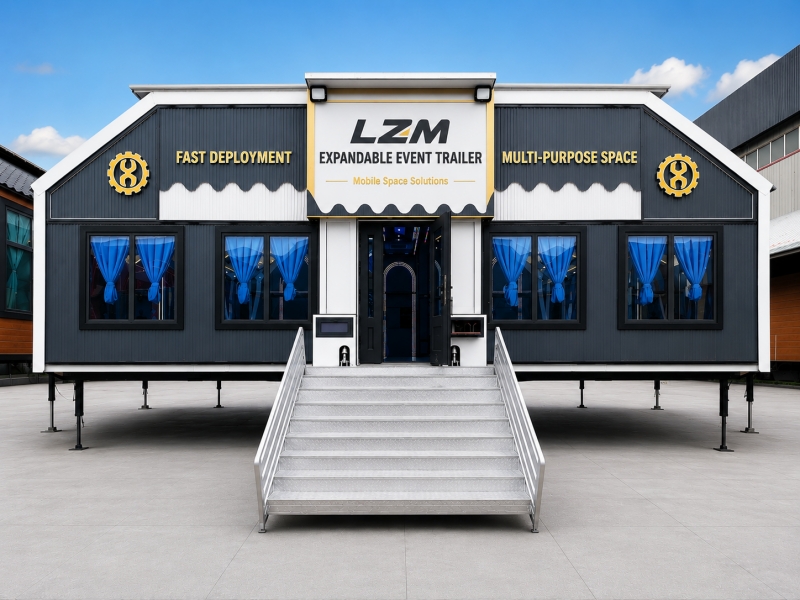
Before discussing options, the manufacturer needs to understand what the buyer actually plans to do with the trailer.
A wedding rental company, exhibition operator, corporate hospitality business, mobile classroom provider, and entertainment company may all purchase the same basic expandable structure.
Their equipment requirements can be completely different.
The first questions should therefore include:
What will the trailer be used for?
How many people will normally use it?
Will it move frequently?
What climate will it operate in?
What equipment will customers expect?
What infrastructure is available at the site?
Configuration should follow the operating model—not the other way around.
The exact standard configuration depends on the model and agreed specification, but buyers should first focus on the systems required for the expandable structure itself.
These may include elements such as:
Main structural system
Hydraulic expansion system
Hydraulic supporting legs
Floor
Interior wall and ceiling finish
Basic lighting
Electrical distribution
Doors and windows
Basic interior wiring
The buyer should confirm the final specification in the quotation rather than assuming that every trailer advertised online includes exactly the same equipment.
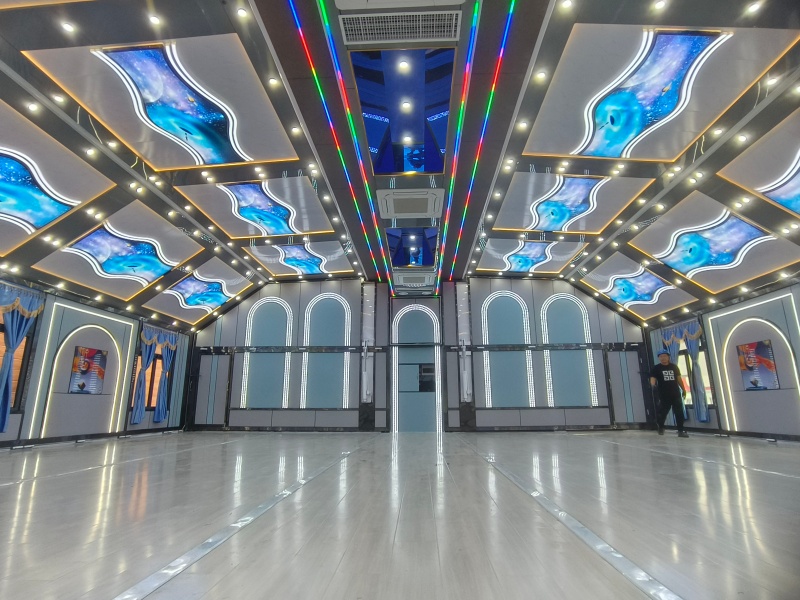
Air conditioning and heating are different from loose furniture or portable entertainment equipment.
They influence electrical load, installation positions, ducting or equipment mounting, interior design, and overall project planning.
Buyers should therefore provide information about:
Destination country
Summer temperature
Winter temperature
Expected occupancy
Operating season
Typical event duration
A trailer operating in Dubai has very different cooling requirements from one operating in a cooler climate.
Climate-control equipment should be selected according to the actual operating environment rather than simply copying another customer's configuration.
An expandable event trailer can accommodate various entertainment and presentation systems.
Possible options include:
Sound system
Microphones
Projectors
LED displays
Large televisions
Stage lighting
Control equipment
But should the manufacturer install all of them?
Not necessarily.
A wedding operator may want a complete integrated entertainment package.
An event rental company may already own professional audio equipment and prefer to use its existing inventory.
A corporate event business may need LED screens but have little use for a permanent DJ system.
Buyers should compare the value of factory integration with the flexibility of locally sourced equipment.
A stage can consume significant interior floor area.
Before adding one, buyers should consider whether it will be used at most events.
For example:
A conference operator may regularly need a presentation stage.
A banquet business may want a stage for weddings and performances.
A flexible rental company serving many types of clients may prefer removable staging.
The same principle applies to bars, counters, partitions, reception desks, and other large interior elements.
Fixed equipment can create a more integrated interior, but removable equipment can make the space more adaptable.
An integrated restroom sounds convenient, but it affects much more than interior decoration.
Buyers may need to consider:
Fresh-water supply
Wastewater
Plumbing
Tank capacity
Cleaning
Ventilation
Interior floor area
Local sanitation requirements
For some projects, an external mobile restroom may preserve more valuable event space inside the expandable trailer.
For others, integrated facilities may be important.
The decision should be based on the operating site and business model rather than assuming every event trailer needs an onboard restroom.
International buyers do not necessarily need every component installed in China.
Some equipment may be easier to purchase or service locally.
Possible examples include:
Furniture
Televisions
Certain audio equipment
Decorative items
Kitchen equipment
Internet systems
Specialized electrical devices
Local sourcing can sometimes simplify replacement, servicing, voltage compatibility, or compliance.
Factory installation may be more appropriate when the equipment is closely integrated into the trailer structure.
A useful purchasing question is therefore:
“Does this equipment need to be integrated during manufacturing, or can I install it locally after delivery?”
Electrical systems deserve particular attention because different countries and projects may use different standards.
Buyers should confirm:
Voltage
Frequency
Phase requirements
Expected total equipment load
HVAC load
Lighting load
Audio and video equipment
Kitchen or specialized equipment
LZM event trailers commonly use a 380V three-phase electrical configuration, with 50Hz or 60Hz depending on the project.
However, the final electrical design should be discussed according to the destination market and intended equipment.
Every custom feature adds more than material cost.
It can also affect:
Engineering
Production time
Electrical design
Weight
Maintenance
Spare parts
Future modification
Resale flexibility
A highly specialized trailer may be ideal for one specific business but less adaptable if the owner's business changes later.
For rental companies in particular, flexibility can have considerable commercial value.
More customization is not automatically a better investment.
A simple purchasing method is to divide the specification into three groups.
Equipment required for the trailer to perform its primary function.
Examples might include HVAC, electrical systems, lighting, and essential interior infrastructure.
Equipment directly connected to the buyer's revenue model.
This might include a wedding stage, presentation screens, specialized seating, or branded reception areas.
Features that would be useful but are not required to begin operations.
These may be purchased later if the business proves demand for them.
This approach can make both budgeting and technical discussions more efficient.
A meaningful quotation requires more than:
“Please send your best price for an event trailer.”
Buyers should ideally provide:
Intended application
Required guest capacity
Preferred trailer size, if known
Destination country
Interior layout requirements
HVAC requirements
Audio and video requirements
Stage requirements
Restroom requirements
Electrical standard
Expected relocation frequency
Required optional equipment
Reference photos, sketches, or examples of the desired interior are also useful.
The manufacturer can then separate the base configuration from project-specific options.
A long equipment list can make a quotation look impressive, but it does not necessarily create a better event trailer.
The objective should be to configure a trailer around the buyer's actual operation while avoiding equipment that adds cost, complexity, and maintenance without contributing meaningful business value.
For many buyers, the right purchasing sequence is:
Application → Essential Systems → Business Equipment → Local Requirements → Optional Features → Final Configuration
LZM develops expandable event trailers according to the customer's application, capacity, destination market, interior requirements, and operating model.
Review the expandable platform and discuss which configuration your project actually requires:
Expandable Event Trailer Configuration & Customization Options