Welcome: Laizhou Machinery Group



Chile presents an unusual combination of operating environments for caravan businesses.
A caravan may be used for long-distance highway travel, gravel roads, mountainous regions or remote destinations where access to services is limited.
For importers and dealers, this creates a more complicated purchasing question than simply selecting an attractive caravan model.
The specification needs to consider terrain, altitude, temperature, towing conditions, off-grid duration and total caravan weight.
A caravan intended for demanding mountain travel should therefore be evaluated as a complete vehicle system.
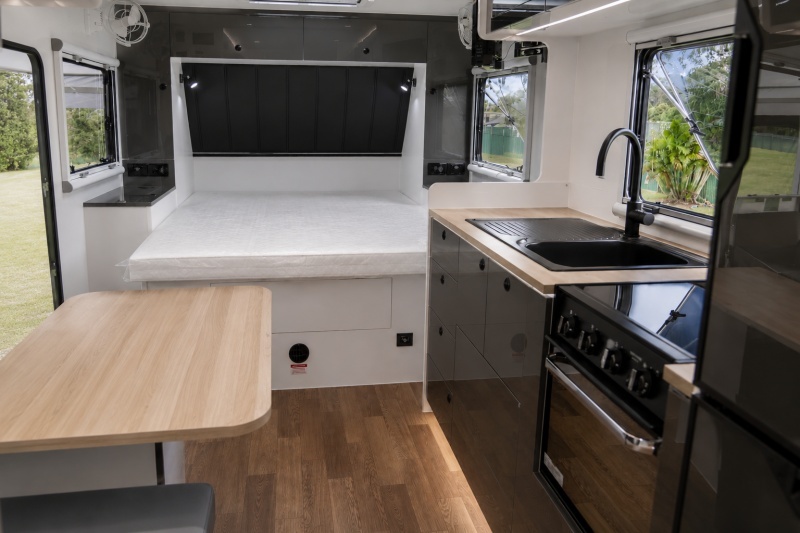
Mountain and remote-road operation can expose a caravan to:
Steep gradients
Uneven surfaces
Gravel roads
Repeated vibration
Long descents
Changing temperatures
Limited access to service facilities
These conditions affect several components simultaneously.
For dealers, important areas include:
Chassis
Suspension
Braking
Ground clearance
Tyres
Weight distribution
Electrical system
The term off road suspension alone does not tell an importer whether a caravan is appropriate for a particular application.
The manufacturer needs to understand where the caravan will operate.
A caravan used primarily on paved roads with occasional gravel sections may require a different configuration from one regularly travelling over rough remote routes.
Suspension planning should consider:
Loaded caravan weight
Axle configuration
Expected terrain
Ground clearance
Wheel and tyre specification
The objective is not simply to install the strongest-looking suspension system, but to match the system to the complete caravan.
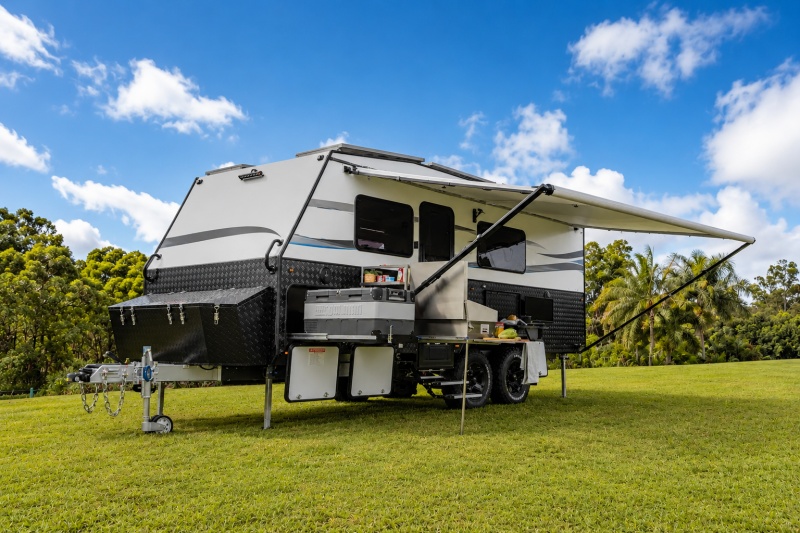
Ground clearance can help protect the underside of a caravan when travelling over uneven terrain.
Important areas that may require consideration include:
Chassis
Water tanks
Plumbing
Steps
Stabilizing equipment
Other underbody components
However, increasing ground clearance also changes the overall vehicle geometry.
Higher is not automatically better.
The manufacturer should balance underbody clearance with stability and overall design.
Mountain travel is not only about climbing.
Long descents can place additional demands on towing and braking systems.
For importers, braking specifications should be considered according to:
Caravan weight
Axle configuration
Tow vehicle
Intended operating environment
Applicable local requirements
Safety-critical braking components should be selected and maintained according to the requirements of the destination market.
A dealer should not evaluate an off road caravan only by suspension and chassis while ignoring braking performance.
A heavily equipped caravan may contain:
Large freshwater tanks
Lithium batteries
Solar systems
Spare wheels
Air conditioning
Additional storage
Outdoor equipment
Each upgrade increases weight.
For mountain travel, dealers should pay particular attention to the final loaded configuration, not only the empty caravan.
The relationship between caravan mass and tow vehicle capability needs to be considered according to applicable local regulations and vehicle ratings.
Two caravans with the same total weight may not behave identically.
The location of heavy components matters.
Examples include:
Batteries
Freshwater tanks
Spare wheels
Gas cylinders
Storage compartments
When an importer requests OEM changes, the manufacturer should consider how those changes affect the complete weight distribution.
Adding a large battery bank or water tank wherever space is available is not good product planning.
Altitude can affect certain equipment and systems, depending on their design.
Importers planning products for mountain regions should discuss operating conditions for equipment such as:
Heating systems
Cooking appliances
Generators, if applicable
Refrigeration equipment
Other combustion-based devices
The operating limitations of the specific component should be checked rather than assuming every appliance performs identically at all elevations.
This is particularly important when developing a caravan intended for a defined high-altitude application.
Chile covers very different climates.
For mountain and southern travel, customers may require heating rather than focusing only on air conditioning.
An OEM specification may need to consider:
Insulation
Heating system
Hot water
Window performance
Door sealing
Electrical capacity
Thermal performance should be treated as a complete system.
Installing a powerful heater cannot fully compensate for poor insulation or excessive heat loss.
Battery performance can be affected by temperature.
For caravans intended for colder environments, dealers should discuss:
Battery operating temperature range
Installation location
Battery management system
Charging limitations
Component protection
The actual requirements depend on the selected battery system.
This is another reason why an OEM specification should identify the intended operating climate before production.
Solar systems are valuable for remote travel, but actual energy production depends on conditions such as:
Available sunlight
Season
Panel orientation
Installed capacity
Weather
Electrical consumption
A customer travelling in remote mountain regions should not assume that a large solar system guarantees unlimited power.
Dealers should balance:
solar generation + battery storage + appliance consumption + alternative charging
as one electrical system.
Tyres influence:
Road contact
Ground clearance
durability
Serviceability
For an importer, another practical consideration is replacement availability.
An unusual tyre size may look attractive on a showroom caravan but become inconvenient if customers cannot obtain replacements easily.
For commercial distribution, dealers should consider both technical suitability and local service availability.
A customer experiencing a small component failure near a major city may find service relatively easily.
The same problem in a remote area can become much more disruptive.
For dealers targeting adventure travellers, useful spare-parts planning may include:
Electrical components
Water-system components
Seals and hardware
Running components
Common service items
Where practical, standardized components can make long-term maintenance easier.
Before confirming an OEM caravan specification, dealers should ask:
What suspension configuration is used?
What is the ground clearance?
Which underbody components require protection?
What braking system is specified?
What is the final loaded-weight target?
How are batteries and water tanks positioned?
What heating options are available?
Is the selected equipment suitable for high-altitude operation?
What are the battery temperature limitations?
Which tyre specifications are used?
Which replacement components should be stocked locally?
Can the same technical configuration be maintained for repeat orders?
These questions provide a much better basis for procurement than simply asking whether a caravan is "off road."
LZM works with international dealers and importers requiring caravan configurations for different terrain, climate and commercial applications.
Chassis, suspension, electrical systems, water capacity and interior equipment can be considered according to the intended market.
Importers evaluating products for demanding travel conditions can explore the Off Road Caravan Models for Remote Travel.
For dealers requiring a larger family-oriented platform, the LZM 21ft model can be discussed with different equipment packages according to the project.
Relevant considerations can include:
Suspension
Battery capacity
Solar system
Water storage
Heating
Interior layout
Storage requirements
Explore the 21ft Off Road Caravan for Mountain and Adventure Travel.
For a Chilean importer or dealer, useful project information includes:
Primary operating region
Expected road conditions
Typical altitude
Customer type
Preferred caravan size
Heating requirements
Battery and solar requirements
Water capacity
Expected purchasing quantity
LZM can use this information to discuss a more appropriate OEM configuration for the intended application.
A mountain-oriented off road caravan cannot be defined by aggressive tyres and high ground clearance alone.
Suspension, braking, loaded weight, weight distribution, heating, batteries, tyres and serviceability all contribute to the real operating capability of the product.
For Chilean dealers, defining the intended terrain and climate before selecting the specification can help avoid both under-specifying the caravan and adding expensive equipment that customers do not actually need.
That makes the final product easier to position, support and reproduce for future orders.